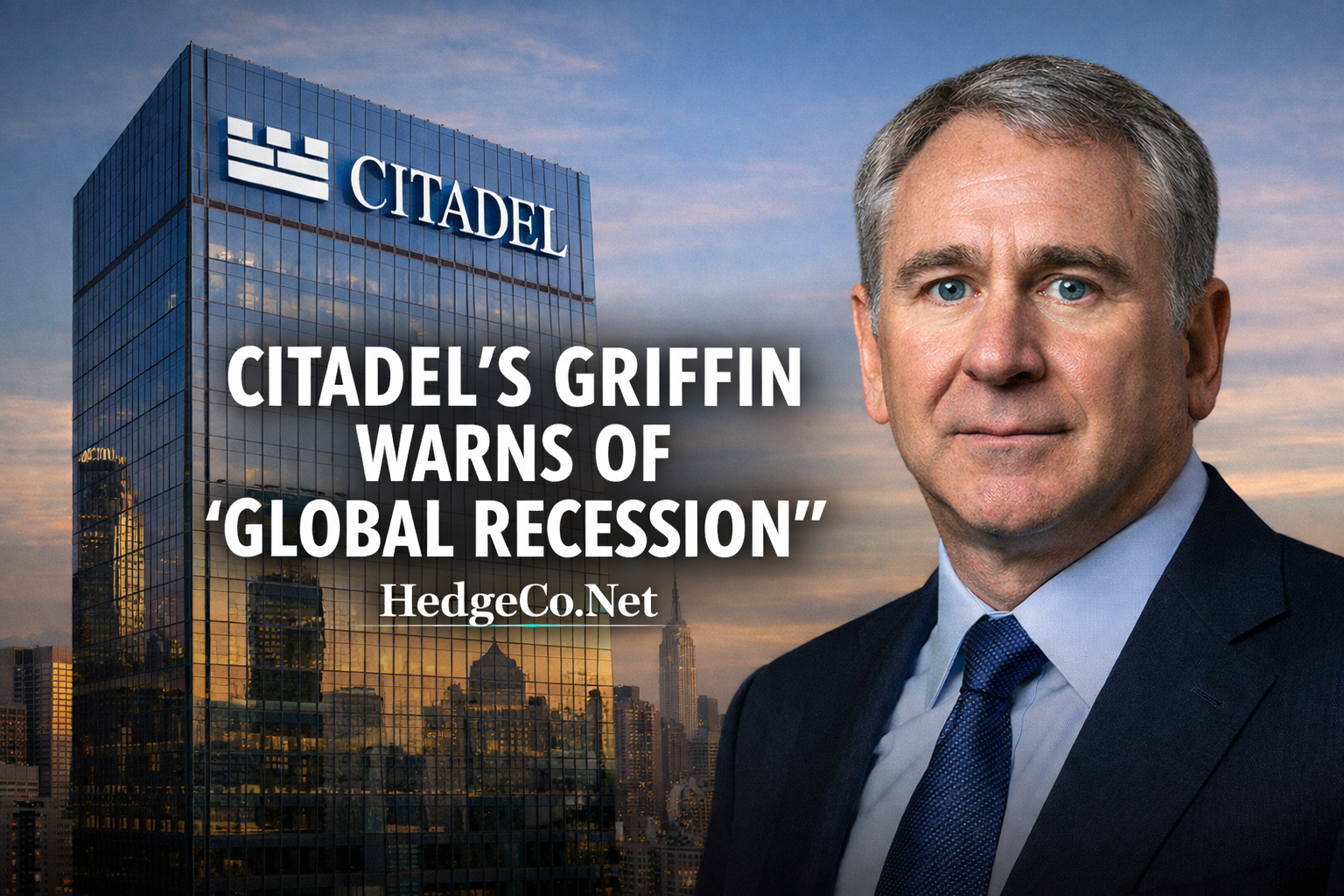
(HedgeCo.Net) — At a high-profile global economic summit this week, Ken Griffin delivered one of the starkest macroeconomic warnings of 2026, cautioning that the global economy could tip into a full-scale recession if disruptions in the Strait of Hormuz persist beyond six months. His remarks, directed at an audience of central bankers, sovereign wealth funds, and institutional investors, underscored growing concern that geopolitical instability—particularly in energy-critical regions—could catalyze a systemic economic shock reminiscent of past oil crises.
Griffin’s warning was not framed as a tail risk, but rather as a base-case scenario should current tensions escalate. “What we are witnessing is the early stage of a classic energy shock,” he stated, drawing direct parallels to the oil supply disruptions of the 1970s. “The difference today is that global financial systems are more interconnected, more leveraged, and more dependent on continuous liquidity than at any time in modern history.”
The Strait of Hormuz: A Critical Fault Line

At the center of Griffin’s concern lies the Strait of Hormuz, one of the most strategically vital maritime passages in the world. Roughly 20% of global oil consumption flows through this narrow corridor each day, linking Persian Gulf producers to international markets. Any prolonged closure or disruption—whether through military conflict, sanctions escalation, or infrastructure sabotage—would send immediate shockwaves through global energy markets.
Energy analysts have already begun pricing in elevated risk premiums, with crude oil volatility surging in recent weeks. While markets have historically demonstrated resilience to short-term disruptions, Griffin emphasized that duration—not just intensity—will determine the macroeconomic outcome.
“A temporary spike in oil prices is manageable,” he noted. “But a sustained supply constraint over multiple quarters fundamentally alters the inflation trajectory, corporate margins, and consumer behavior globally.”
The Anatomy of an Energy Shock
Griffin’s reference to a “classic energy shock” invokes a well-documented economic sequence. Historically, such shocks begin with a sudden supply disruption, followed by a rapid increase in energy prices. This, in turn, feeds into broader inflation as transportation, manufacturing, and consumer goods costs rise.
However, the second-order effects are often more damaging. Central banks, already grappling with persistent inflation in the post-pandemic era, may be forced to maintain or even tighten monetary policy despite weakening growth. The result is a policy dilemma: support economic activity or contain inflation.
This dynamic is particularly acute in 2026, where many developed economies have only recently stabilized after years of aggressive rate hikes. Griffin warned that policymakers may have limited flexibility to respond effectively.
“We are entering this potential shock with elevated debt levels, constrained fiscal capacity, and central banks that are still credibility-focused on inflation control,” he said. “That is not an ideal starting point.”
A Fragile Global Economy

While headline economic data in the United States and parts of Europe have remained resilient, underlying indicators suggest a more fragile backdrop. Manufacturing activity has slowed across key regions, global trade volumes have plateaued, and corporate earnings growth has become increasingly uneven.
Griffin highlighted the divergence between headline strength and underlying vulnerability. “We are seeing pockets of resilience, particularly in services and certain consumer sectors,” he acknowledged. “But beneath that, there is a growing softness in industrial activity, capital expenditure, and global trade.”
Emerging markets, in particular, face heightened risk. Many are heavily dependent on energy imports and lack the monetary policy tools available to developed economies. A sustained rise in oil prices could trigger currency instability, capital outflows, and sovereign stress in vulnerable regions.
The Hedge Fund Perspective: Positioning for Volatility
As the founder and CEO of Citadel, Griffin’s perspective carries significant weight within the hedge fund community. Citadel, known for its multi-strategy approach and sophisticated risk management, has historically thrived in volatile environments. Yet Griffin’s tone suggested caution rather than opportunism.
“This is not just another volatility regime,” he emphasized. “This is a potential structural shift in the macro landscape.”
Hedge funds have already begun adjusting their positioning. Market-neutral strategies, which aim to generate returns independent of market direction, have seen renewed interest from institutional allocators. Commodity-focused funds are increasing exposure to energy markets, while macro funds are recalibrating interest rate and currency positions.
At the same time, risk managers are placing greater emphasis on liquidity. In a scenario where market dislocations become severe, the ability to exit positions quickly can be as important as the positions themselves.
Criticism of Global Policy Coordination
One of the more pointed elements of Griffin’s remarks was his critique of the lack of a unified global response to escalating geopolitical tensions. He argued that fragmented policymaking and inconsistent messaging have exacerbated market uncertainty.
“In past crises, we have seen coordinated action among major economies—whether through strategic petroleum reserves, monetary policy alignment, or diplomatic engagement,” he said. “Today, that coordination appears limited.”
The absence of a cohesive response could amplify the economic impact of any prolonged disruption. Without coordinated efforts to stabilize energy markets, individual countries may pursue protectionist measures, further distorting global supply chains.
Energy Markets and Inflation: A Dangerous Feedback Loop
A key concern highlighted by Griffin is the feedback loop between energy prices and inflation. Higher oil prices translate directly into increased transportation and production costs, which are ultimately passed on to consumers. This can erode purchasing power and dampen demand, even as headline inflation remains elevated.
For central banks, this creates a challenging environment. Lowering interest rates to support growth risks fueling further inflation, while maintaining tight policy could exacerbate economic contraction.
“This is the worst kind of inflation shock,” Griffin noted. “It is supply-driven, persistent, and difficult to offset through traditional policy tools.”
Implications for Institutional Investors
Institutional investors—including pension funds, endowments, and sovereign wealth funds—are closely monitoring the evolving situation. Many have already begun reassessing portfolio allocations in light of rising geopolitical risk.
Diversification strategies are being revisited, with increased emphasis on real assets, commodities, and alternative investments that can provide inflation protection. Private credit, infrastructure, and energy-related assets are attracting renewed interest as investors seek stable, income-generating opportunities.
However, Griffin cautioned that traditional diversification may not be sufficient in a systemic shock scenario. “Correlation structures can break down in extreme environments,” he warned. “Assets that are typically uncorrelated can suddenly move in tandem.”
The Role of Energy Transition and Long-Term Outlook
While Griffin’s remarks focused on near-term risks, they also raised broader questions about the global energy transition. The push toward renewable energy and decarbonization has accelerated in recent years, but the current crisis highlights the continued importance of traditional energy sources.
A prolonged disruption in oil supply could accelerate investment in alternative energy infrastructure, but such transitions take time. In the interim, the global economy remains heavily dependent on fossil fuels.
“This is a reminder that energy security is not just an environmental issue—it is a core economic issue,” Griffin said.
Market Scenarios: What Happens Next?
Looking ahead, several scenarios could unfold depending on the trajectory of geopolitical developments:
- Short-Term Disruption (1–3 months): Markets experience volatility, but economic impact remains contained. Central banks maintain current policy stance.
- Medium-Term Disruption (3–6 months): Inflation rises significantly, growth slows, and risk assets face sustained pressure.
- Prolonged Disruption (6+ months): Global recession becomes likely, with widespread economic contraction and potential financial instability.
Griffin’s warning is most closely aligned with the third scenario, which he described as increasingly plausible if current tensions are not resolved.
Conclusion: A Defining Moment for Global Markets
Ken Griffin’s warning serves as a stark reminder of the interconnected nature of modern financial systems. A disruption in a single geographic chokepoint can cascade through energy markets, inflation dynamics, monetary policy, and ultimately global economic growth.
For investors, policymakers, and market participants, the message is clear: the risks are not hypothetical—they are unfolding in real time.
As Griffin concluded in his remarks, “We are at a moment where decisions made over the next few months could shape the global economic trajectory for years to come. The question is whether we act decisively—or react too late.”