(HedgeCo.Net) The hedge fund industry is experiencing its strongest capital-raising momentum since the pre-financial-crisis era, marking a major shift in allocator behavior after years in which private credit, private equity, venture capital, and passive equity strategies absorbed much of the institutional spotlight.
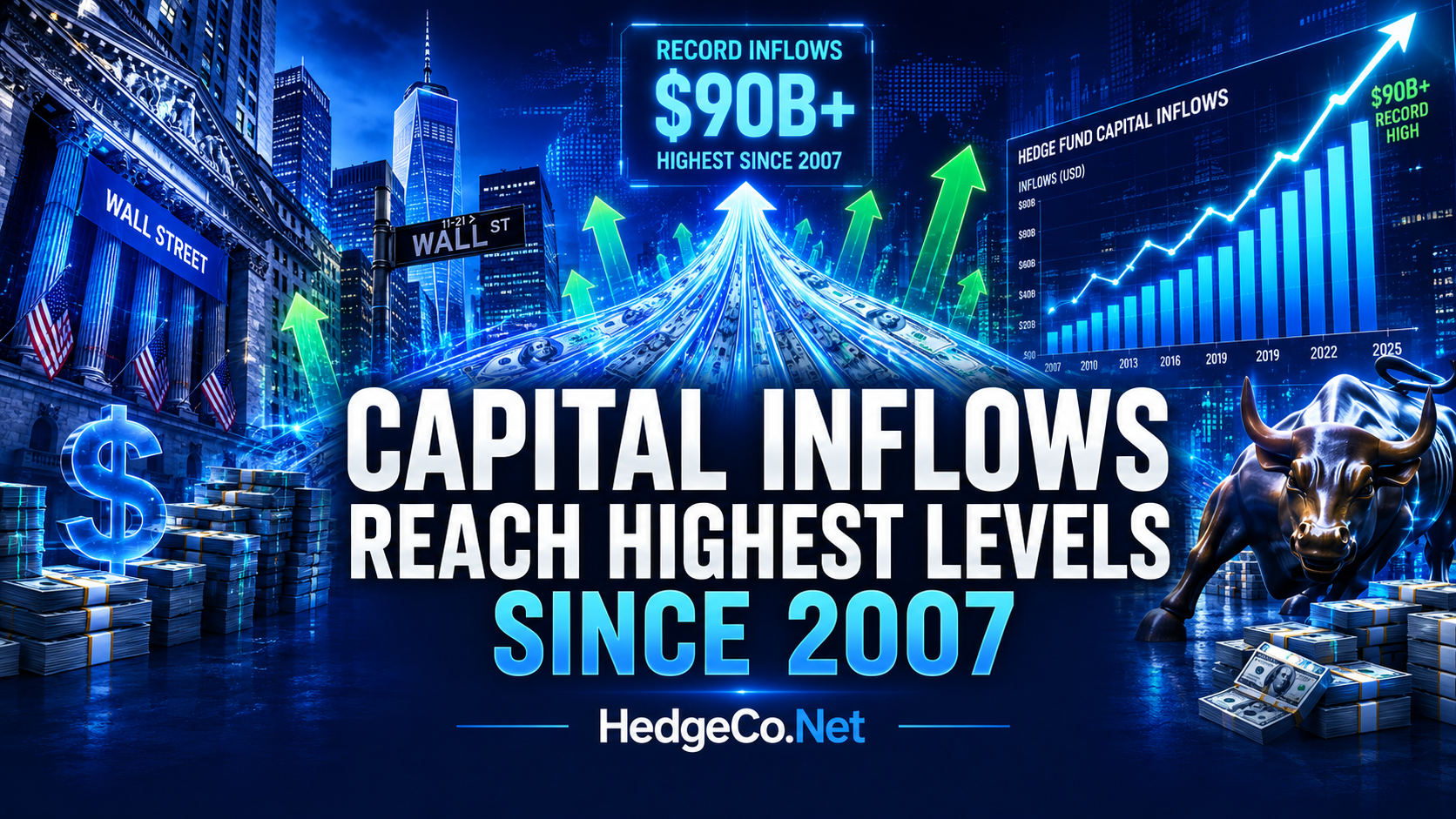
According to Hedge Fund Research, the industry attracted nearly $45 billion of new capital in the first quarter of 2026, and almost $90 billion of net inflows over the last two quarters—the strongest two-quarter inflow period since 2007. That surge follows a powerful 2025, when hedge funds gathered roughly $116 billion in net inflows, also the highest annual figure since 2007, while total industry capital climbed above the historic $5 trillion threshold.
The numbers are important because they signal more than a cyclical rebound. They suggest a structural reassessment of hedge funds inside institutional portfolios. After years of criticism over fees, uneven performance, crowding, and competition from cheaper liquid alternatives, hedge funds are again being treated as a core allocation tool by pensions, sovereign wealth funds, endowments, foundations, family offices, insurers, and wealth platforms.
The catalyst is not simply performance. It is the market environment.
Investors are confronting a world defined by elevated geopolitical risk, persistent inflation uncertainty, rate volatility, fiscal stress, AI-driven equity concentration, and periodic breakdowns in traditional stock-bond diversification. In that environment, allocators are looking for strategies that can generate returns without relying entirely on rising equity markets or falling interest rates. Hedge funds, particularly macro, multi-strategy, market-neutral, relative value, event-driven, and long/short equity strategies, are being repositioned as tools for diversification, liquidity, and alpha generation.
The timing is notable. The industry’s capital-raising renaissance is occurring even as public markets remain volatile and private markets face a more complicated exit environment. Many institutions have become overallocated to illiquid assets after years of strong commitments to private equity and private credit. With distributions slower and portfolio liquidity more valuable, hedge funds offer something that locked-up private funds cannot always provide: tactical flexibility.
That flexibility is becoming more valuable.
For much of the post-2008 era, the investment case for hedge funds was under pressure. Central bank liquidity suppressed volatility, equity beta was cheap and powerful, and many hedge fund strategies struggled to justify high fees. The rise of passive investing also changed the benchmark for active management. If public equity indices could deliver strong returns with minimal cost, investors were less willing to pay hedge fund fees for modest or inconsistent alpha.
But the regime has changed. Since the rate-hiking cycle began in 2022, markets have become more dispersion-driven and less dependent on synchronized central bank support. Goldman Sachs noted earlier this year that hedge funds entered 2026 with strong momentum after a second consecutive year of double-digit returns in 2025 and that the higher-rate environment has created more opportunity for managers to outperform benchmarks.
That matters because hedge funds do best when markets are less uniform. When dispersion rises across sectors, stocks, rates, currencies, commodities, credit, and geographies, active managers have more ways to express differentiated views. Long/short equity managers can profit from winners and losers inside the same sector. Macro managers can trade interest-rate divergence, currency volatility, sovereign risk, and commodity shocks. Relative value funds can exploit mispricings created by liquidity stress, balance-sheet constraints, and regulatory distortions. Multi-strategy platforms can allocate capital dynamically across all of these opportunities.
The result is renewed institutional interest.
HFR’s latest data show that hedge funds generated positive quarterly returns in Q1 2026 even as U.S. equities declined, reinforcing the argument that hedge funds can provide resilience when equity markets wobble. HFR also emphasized that macro strategies, among the lowest-correlated categories, were leading performance returns during the quarter.
That is exactly the profile many allocators want. They are not simply chasing returns; they are buying portfolio behavior. They want capital that can behave differently from equities, long-duration bonds, and illiquid private assets. The renewed inflows suggest hedge funds are increasingly being evaluated not just on stand-alone performance, but on their role inside total portfolio construction.
The nearly $90 billion two-quarter inflow figure is especially significant because hedge fund asset gathering has historically been highly sensitive to sentiment. When investors lose confidence in hedge fund performance, redemptions can accelerate quickly. When performance improves and market uncertainty rises, capital can return just as quickly—but usually to a narrow group of managers.
That appears to be happening again.
Large, established firms are likely capturing a meaningful share of new allocations. Institutional investors tend to prefer managers with long track records, deep infrastructure, strong risk controls, transparent reporting, and capacity to absorb large tickets. Multi-manager platforms, macro specialists, quantitative firms, and large long/short equity managers have been among the beneficiaries of this flight to quality.
At the same time, strong demand is not limited to the biggest names. Recent fundraising reports show newer and mid-sized managers also attracting capital when they can demonstrate differentiated performance. Financial News reported this week that High Ground Investment Management, founded by former TCI partner Edgar Allen, raised $550 million in fresh capital in Q1 2026, largely from sovereign wealth funds and institutional investors, increasing total assets to $2.7 billion after strong 2025 and early 2026 performance.
That kind of fundraising illustrates an important point: allocators are not indiscriminately buying the entire hedge fund universe. They are rewarding managers who can show credible alpha, disciplined risk management, and capacity to perform in a more volatile environment.
The industry’s recent inflows also reflect a broader change in how institutions think about liquidity. Private credit and private equity remain major allocation categories, but both have faced more scrutiny as investors assess exit delays, valuation marks, redemption pressure in semi-liquid vehicles, and the practical limits of illiquidity. Hedge funds offer exposure to active management without the same duration lockup as traditional private equity funds.
This does not mean allocators are abandoning private markets. Rather, they are rebalancing. The same institution can believe in private credit income, private equity long-term compounding, and hedge fund diversification at the same time. But after several years of heavy private-market commitments, liquid alternatives are receiving renewed attention as a way to restore flexibility.
That helps explain why hedge funds are being positioned as a middle ground between passive public exposure and illiquid private strategies. They offer active management, tactical opportunity, and diversification, while still generally providing more liquidity than drawdown private funds.
Another major driver is concentration risk in public equities. The AI boom has generated extraordinary gains in a narrow group of technology and infrastructure-related companies, but it has also left many portfolios heavily exposed to a relatively small set of market leaders. Investors who benefited from that concentration are increasingly aware that the same exposure can become a source of vulnerability if leadership reverses.
Hedge funds can help manage that risk. Equity long/short managers can remain invested in AI winners while hedging expensive or vulnerable areas of the market. Market-neutral managers can reduce broad beta while exploiting stock-level dispersion. Macro managers can trade the second-order effects of AI spending on energy, commodities, currencies, rates, and global supply chains.
In other words, hedge funds offer a way to participate in market complexity rather than simply endure it.
The return of capital inflows also strengthens the business position of hedge fund managers. Asset growth improves fee revenue, supports hiring, expands research coverage, and allows firms to invest in technology, data, compliance, and trading infrastructure. The largest platforms have already built enormous operational machines, and renewed inflows may widen the gap between scale players and smaller managers.
That raises a competitive question for the industry. If most new capital flows to the biggest platforms, hedge fund returns could become increasingly concentrated among a small group of institutional-quality firms. This may benefit investors who want stability and infrastructure, but it could also make it harder for emerging managers to compete for attention unless they offer exceptional performance or niche expertise.
Still, the fundraising backdrop is healthier than it has been in years. The industry’s capital base has crossed a major threshold, and allocator sentiment appears to have turned meaningfully positive. HFR reported that total hedge fund capital moved to new records, supported by both performance gains and investor inflows.
The question now is whether the inflow trend can continue.
There are reasons to believe it can. Volatility remains elevated across asset classes. Geopolitical risks are not fading. Inflation remains a live concern. Central banks are no longer providing the same predictable liquidity backstop they did for much of the last cycle. Equity markets are still heavily influenced by AI concentration, earnings dispersion, and uncertainty over rates. These conditions generally favor active, flexible strategies.
J.P. Morgan Asset Management has argued that normalized interest rates, elevated single-stock volatility, and higher equity dispersion together create a stronger alpha-generation environment for hedge funds. BlackRock has similarly noted that hedge funds are well positioned in a world of macro shocks, fiscal uncertainty, geopolitical risk, and changing diversification dynamics.
Those views align with what allocators appear to be doing with capital. The renewed inflows are not just a response to one good quarter. They reflect a belief that the opportunity set has improved.
However, the industry also faces risks.
First, strong inflows can create capacity pressure. Some strategies work best when capital is constrained. If too much money flows into the same trades, alpha can compress and crowding can rise. Multi-strategy platforms have shown an ability to scale through talent acquisition and risk allocation, but even the largest firms face limits.
Second, investor expectations can become too high. After a strong fundraising period, allocators may expect hedge funds to deliver equity-like returns with bond-like risk and low correlation. That is a difficult combination. Hedge funds can diversify portfolios, but they are not immune to losses, drawdowns, crowding, liquidity shocks, or manager-specific mistakes.
Third, fees remain a point of debate. The traditional “2 and 20” model has evolved, but hedge funds remain expensive relative to passive products and many liquid alternatives. Investors are willing to pay for alpha, but only if performance justifies the economics. Renewed inflows will not eliminate fee scrutiny.
Fourth, the industry’s success could invite greater competition from asset managers offering lower-cost alternative strategies, including active ETFs, liquid alternatives, and customized solutions. ETF inflows remain strong across the broader asset management industry, showing that investors are still highly receptive to liquid, transparent, lower-cost vehicles. Barron’s reported that U.S.-listed ETFs attracted $178 billion in April 2026, the second-highest monthly total on record, with actively managed ETFs also gaining momentum.
That matters because hedge funds are not competing only with each other. They are competing with an expanding universe of products that promise active exposure, liquidity, and lower fees. To maintain momentum, hedge funds must continue delivering differentiated outcomes.
The strongest managers understand this. They are investing heavily in data, technology, quantitative infrastructure, artificial intelligence, alternative data, risk systems, and talent. The hedge fund industry has become more institutionalized, more operationally sophisticated, and more competitive than it was in 2007. The current inflow cycle is therefore not simply a return to the pre-crisis hedge fund boom. It is a new phase shaped by institutional scrutiny, platform scale, and a more complex macro environment.
For investors, the key takeaway is that hedge funds are back in the allocation conversation in a major way. The nearly $90 billion two-quarter inflow streak is not an isolated statistic. It is evidence that institutions are rethinking how they want portfolios to behave in a world where traditional diversification has become less reliable and where market leadership is increasingly narrow.
For the alternative investment industry, the implications are broad. Hedge fund managers with strong performance may find fundraising conditions more favorable than at any point in the past decade. Prime brokers, administrators, placement agents, consultants, and data providers may benefit from renewed industry growth. Multi-strategy platforms may continue expanding their influence. Emerging managers with compelling strategies may find that investor conversations are finally reopening.
The industry has spent years defending its relevance. Now the capital is returning.
The challenge is to prove that the renewed confidence is justified. If hedge funds can continue producing uncorrelated returns, protecting capital during volatility, and capturing alpha from dispersion, the inflow cycle could have staying power. If performance slips or crowding undermines returns, investors may again question whether the fees and complexity are worth it.
For now, the momentum is unmistakable. Hedge funds have moved back to the center of institutional allocation strategy, supported by record industry assets, the strongest inflows since 2007, and a market environment that rewards flexibility. After a long period of skepticism, the industry is once again being viewed not as a legacy alternative investment category, but as a necessary tool for navigating the next phase of global markets.