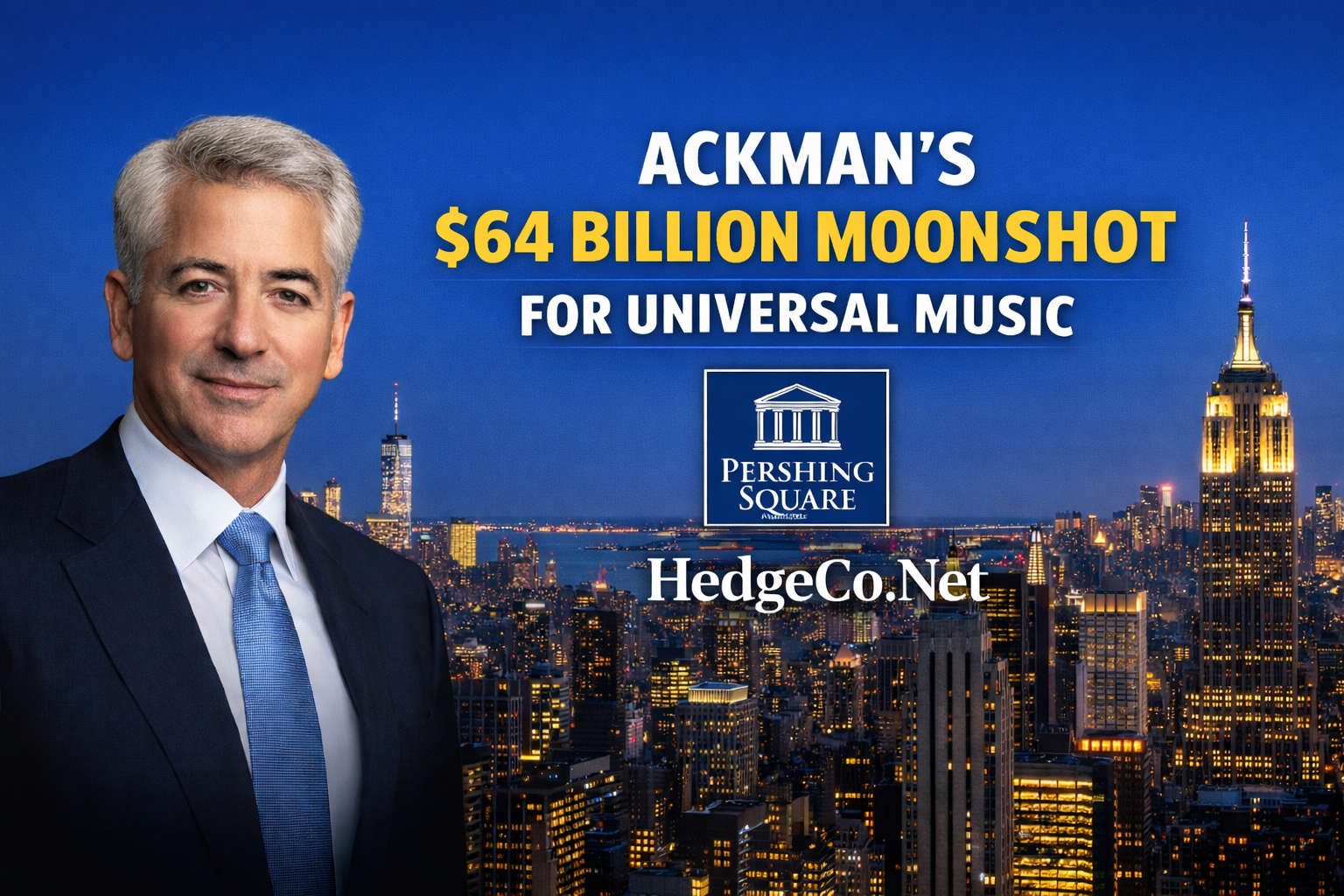
(HedgeCo.Net) In a move that has reverberated across both Wall Street and the global entertainment industry, Bill Ackman is reportedly pursuing a staggering $64 billion transaction to take Universal Music Group (UMG) private. The deal, still contingent on critical support from Vincent Bolloré and his associated holding structures, represents not only one of the largest hedge fund-led buyouts in history—but also a profound shift in how alternative investment firms are approaching intellectual property, media assets, and long-duration cash flow businesses.
If successful, the transaction would mark a defining moment in the evolution of hedge funds from public market specialists into hybrid capital allocators capable of executing mega-scale private equity-style acquisitions. More importantly, it would position Ackman—long known for his concentrated, high-conviction bets—as a central power broker in the global music ecosystem.
The Strategic Logic Behind the Bid
At first glance, the idea of a hedge fund orchestrating a $64 billion take-private of a music company may seem unconventional. But in reality, the logic underpinning Ackman’s move is deeply aligned with structural shifts across both finance and media.
UMG is not just a record label—it is the dominant platform in a global music industry that has undergone a dramatic transformation over the past decade. The shift from physical sales and downloads to streaming has created a more predictable, annuity-like revenue model. Platforms such as Spotify, Apple Music, and YouTube have effectively turned music catalogs into recurring cash flow engines.
For a capital allocator like Ackman, this is precisely the type of asset that fits a long-duration investment thesis:
- High-margin intellectual property
- Global distribution with minimal marginal cost
- Strong pricing power through licensing agreements
- Embedded growth via streaming adoption in emerging markets
In essence, UMG behaves less like a traditional media company and more like a hybrid infrastructure asset—akin to a toll road on global music consumption.
Pershing Square’s Evolution: From Activism to Asset Ownership
Ackman’s firm, Pershing Square Capital Management, has historically been associated with activist investing—taking large stakes in public companies and pushing for operational or strategic change. However, over the past decade, Pershing Square has increasingly shifted toward a more concentrated, long-term ownership model.
The firm’s investment in UMG is not new. Ackman initially gained exposure to the company through a complex transaction involving Vivendi, which spun off UMG in a high-profile listing on the Euronext Amsterdam exchange. That initial investment was widely viewed as one of Ackman’s most successful plays, delivering substantial gains and reinforcing his thesis around the durability of music IP.
The current $64 billion bid represents the logical extension of that conviction. Rather than simply holding a minority stake in a public entity, Ackman is now seeking full control—effectively transitioning from investor to owner-operator.
This evolution mirrors a broader trend across the hedge fund industry, where leading firms are increasingly blurring the lines between hedge funds, private equity, and even sovereign-style capital pools.
The Role of Vincent Bolloré: Kingmaker in the Deal
No discussion of this transaction is complete without understanding the pivotal role of Vincent Bolloré.
Through his influence over Vivendi and related entities, Bolloré has long been a central figure in the ownership structure of UMG. His support—or opposition—could determine the fate of Ackman’s bid.
Bolloré is known for his strategic patience and willingness to back long-term value creation in media assets. However, he is also a notoriously shrewd negotiator, unlikely to relinquish control without extracting maximum value.
The alignment between Ackman and Bolloré is therefore critical. If the two can agree on valuation, governance, and strategic direction, the deal becomes significantly more feasible. If not, the transaction could stall or collapse entirely.
Why Take UMG Private Now?
Timing is everything in large-scale transactions, and Ackman’s move comes at a moment of both opportunity and uncertainty.
1. Public Market Undervaluation
Despite strong fundamentals, many media and entertainment companies have traded at discounted multiples in public markets. Concerns around advertising cycles, platform competition, and macroeconomic volatility have weighed on valuations.
By taking UMG private, Ackman could effectively arbitrage this discount—acquiring a premium asset at a price that may not fully reflect its long-term cash flow potential.
2. Strategic Flexibility
As a private entity, UMG would have greater freedom to pursue long-term initiatives without the pressure of quarterly earnings expectations. This includes:
- Expanding into emerging markets
- Investing in new distribution technologies
- Acquiring additional catalogs and rights
3. Capital Structure Optimization
Private ownership allows for more aggressive use of leverage, structured financing, and bespoke capital arrangements. For a firm like Pershing Square, this opens the door to engineering returns through both operational performance and financial structuring.
The Financial Engineering Behind a $64 Billion Deal
Executing a transaction of this magnitude requires a highly sophisticated financing strategy.
While full details have not been disclosed, market participants expect a combination of:
- Equity from Pershing Square and co-investors
- Debt financing from global banks
- Potential sovereign wealth fund participation
- Structured instruments such as preferred equity or hybrid securities
The involvement of large institutional capital pools—such as pension funds and sovereign wealth funds—would be particularly notable. These investors are increasingly seeking exposure to stable, long-duration assets like music catalogs, making UMG an attractive target.
The Taylor Swift Factor: Cultural Power Meets Financial Control
One of the more widely discussed implications of the deal is its symbolic impact on the music industry—particularly in relation to artists like Taylor Swift.
UMG controls vast portions of the global music catalog, including rights associated with many of the world’s biggest artists. By acquiring the company, Ackman would effectively gain influence over the economic infrastructure of modern music.
While the “landlord” analogy often used in media coverage is somewhat simplistic, it captures a deeper truth: ownership of music rights translates into control over one of the most valuable forms of cultural capital in the digital age.
Implications for the Hedge Fund Industry
Ackman’s bid is not occurring in a vacuum. It is part of a broader transformation within the hedge fund industry.
Firms such as Blackstone, Apollo Global Management, and KKR have already expanded aggressively into private markets, infrastructure, and real assets.
However, traditional hedge funds have been slower to make this transition—until now.
If successful, Ackman’s move could:
- Encourage other hedge funds to pursue similar transactions
- Accelerate the convergence of hedge funds and private equity
- Redefine the competitive landscape for alternative asset managers
Risks and Challenges
Despite its strategic appeal, the deal is not without significant risks.
1. Valuation Risk
At $64 billion, UMG would command a premium valuation. Any miscalculation in growth assumptions or discount rates could impact returns.
2. Execution Risk
Integrating and managing a global media company is fundamentally different from managing a portfolio of public equities. Ackman would need to build or partner with an operational team capable of running UMG at scale.
3. Regulatory Scrutiny
Given the size and strategic importance of the transaction, regulators in multiple jurisdictions could subject the deal to intense scrutiny.
4. Market Dynamics
The music industry, while more stable than in the past, is still subject to technological disruption. Changes in streaming economics, platform power, or consumer behavior could impact long-term cash flows.
The Bigger Picture: Financialization of Intellectual Property
Perhaps the most important takeaway from Ackman’s bid is what it signals about the future of investing.
Intellectual property—whether music, film, or data—is increasingly being treated as a core asset class. Institutional investors are recognizing that these assets can deliver:
- Stable, recurring income
- Low correlation to traditional markets
- Inflation protection through pricing power
In this context, UMG is not just a music company—it is a gateway to one of the most scalable and durable forms of value creation in the modern economy.
Conclusion: A Defining Bet for a Changing Industry
Bill Ackman has built his reputation on bold, high-conviction bets. From his early activist campaigns to his high-profile successes and setbacks, his career has been defined by a willingness to challenge conventional thinking.
The $64 billion bid for Universal Music Group may ultimately prove to be his most ambitious move yet.
If successful, it would:
- Cement Ackman’s status as a leading figure in alternative investments
- Redefine the role of hedge funds in private markets
- Accelerate the institutionalization of intellectual property as an asset class
But even if the deal does not materialize, its mere existence signals a profound shift in how capital is being deployed at the highest levels of finance.
The lines between hedge funds, private equity, and strategic ownership are blurring. And in that convergence, a new model of investing is emerging—one where control, scale, and long-term vision matter more than ever.
In that world, a hedge fund buying the world’s largest music company no longer seems improbable. It seems inevitable.