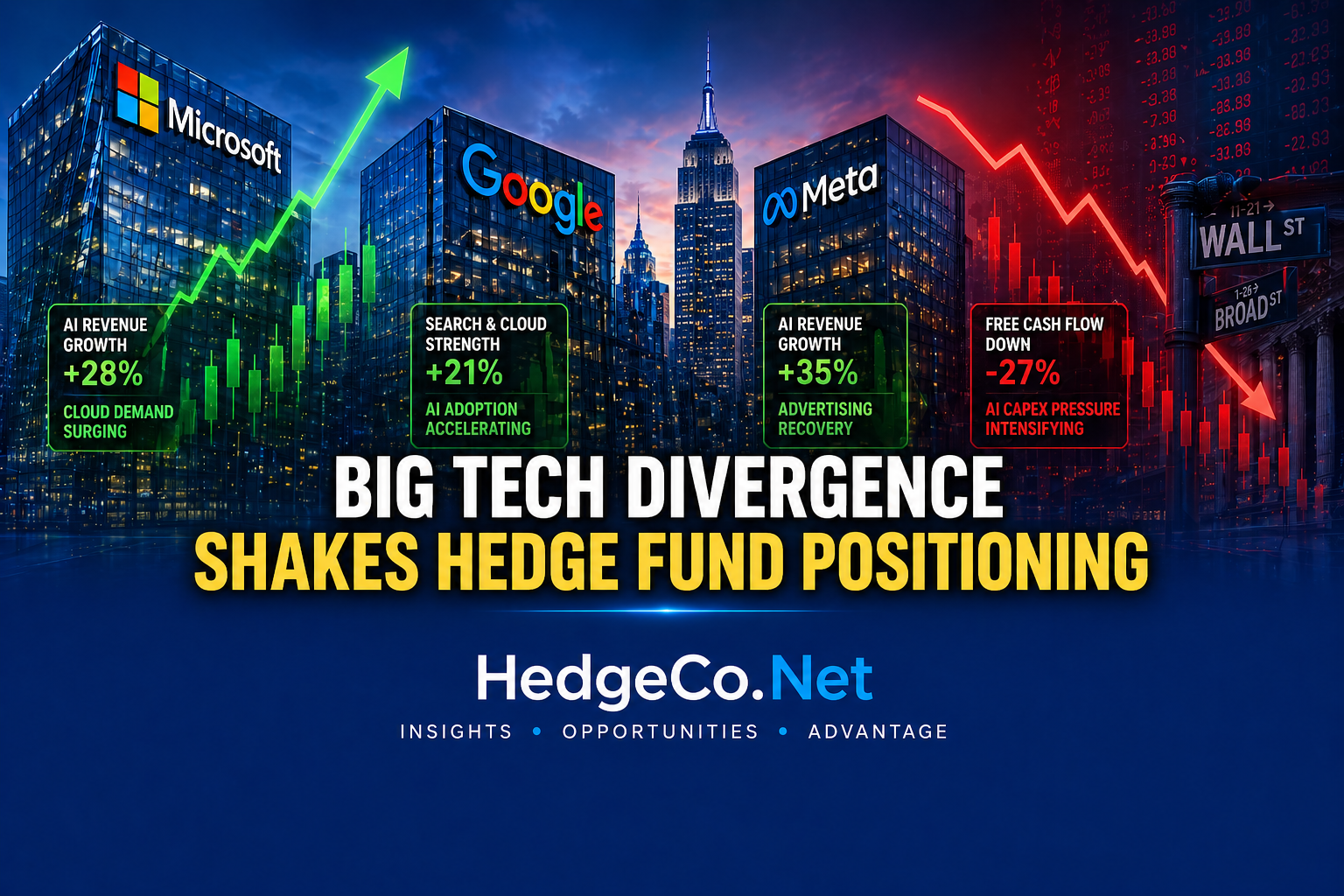
(HedgeCo.Net) A defining shift is underway across global equity markets—and hedge funds are moving quickly to adapt. Following a volatile earnings cycle among the largest technology companies, a growing divergence within the so-called “Magnificent 7” is forcing portfolio managers to reassess one of the most crowded trades in modern market history.
For much of the past decade, mega-cap technology stocks moved in near lockstep, driven by consistent revenue growth, expanding margins, and dominant market positioning. Today, that cohesion is breaking down. While artificial intelligence continues to fuel top-line expansion, unprecedented capital expenditures tied to AI infrastructure are beginning to pressure free cash flow, fragmenting investor consensus and reshaping hedge fund positioning across the sector.
The result is a market dynamic that is no longer defined by broad-based “Big Tech beta,” but by increasingly granular, company-specific narratives—each with distinct implications for valuation, capital allocation, and risk.
The End of Uniformity: A Trade Begins to Fracture
At the center of this divergence are three of the most closely watched firms in global markets: Microsoft, Alphabet, and Meta Platforms.
Each has reported strong AI-driven revenue growth, reinforcing the long-term bullish thesis surrounding artificial intelligence. Yet beneath the surface, a more complicated picture is emerging. Massive increases in capital expenditures—particularly related to data centers, GPUs, and cloud infrastructure—are weighing heavily on near-term profitability metrics.
For hedge funds, this presents a dilemma. On one hand, AI represents one of the most powerful secular growth trends in decades. On the other, the cost of participating in that growth is rising rapidly, creating a disconnect between revenue momentum and cash flow generation.
This tension is at the core of the current divergence.
AI Revenue vs. AI Spending: The New Battleground
The fundamental issue is not demand—it is cost. Artificial intelligence is extraordinarily resource-intensive. Training large language models and deploying AI services at scale requires vast investments in compute infrastructure. Companies are spending tens of billions of dollars annually on:
- Data center construction
- Advanced semiconductor procurement (GPUs and accelerators)
- Networking and storage systems
- Energy and cooling infrastructure
For firms like Microsoft and Alphabet, these investments are essential to maintaining leadership in cloud computing and AI services. However, they are also compressing margins and reducing free cash flow in the short term. This has created a bifurcation in investor interpretation:
- Bullish View: AI capex is a necessary upfront investment that will generate exponential returns over time
- Bearish View: The cost curve is rising faster than monetization, leading to prolonged margin pressure
Hedge funds are increasingly positioning around this divide.
Hedge Fund Positioning: From Consensus to Dispersion
For much of 2023–2025, the “Magnificent 7” trade was one of the most crowded positions across hedge funds. Multi-strategy platforms, long/short equity funds, and even macro managers maintained significant exposure to large-cap tech, often as a core long position. That consensus is now breaking apart.
Recent positioning data indicates a sharp increase in dispersion across hedge fund portfolios. Rather than maintaining uniform exposure, managers are selectively overweighting or underweighting individual names based on their views on AI monetization, capital efficiency, and competitive positioning.
Key trends include:
- Rotation within Tech: Funds are shifting capital between mega-cap names rather than exiting the sector entirely
- Increased Hedging: Options strategies and pair trades are being used to manage divergence risk
- Short Positions Emerging: Some managers are beginning to short companies perceived as over-investing relative to near-term returns
This marks a significant evolution in how hedge funds approach the sector—from broad thematic exposure to highly differentiated, alpha-driven positioning.
Free Cash Flow Compression: The Critical Metric
While revenue growth remains strong, free cash flow has emerged as the critical battleground metric. Historically, mega-cap tech companies were prized for their ability to generate substantial free cash flow, which supported:
- Share buybacks
- Dividend payments
- Strategic acquisitions
Today, that dynamic is changing. As capex increases, free cash flow is declining across several major players. This has implications not only for valuation multiples, but also for investor sentiment.
Hedge funds are particularly sensitive to this shift. In an environment where interest rates remain elevated and capital is no longer “free,” cash flow generation is once again a primary driver of valuation.
The question facing managers is whether current capex levels represent a temporary investment phase—or a structural change in the cost base of the industry.
Macro Overlay: Rates, Liquidity, and Risk Appetite
The divergence within Big Tech is occurring against a complex macro backdrop. Central bank policy remains a key variable. With the Federal Reserve maintaining a cautious stance on rate cuts, the cost of capital remains elevated relative to the ultra-low-rate environment of the previous decade.
This has several implications:
- Discount Rates Matter More: Higher rates reduce the present value of future earnings, impacting high-growth tech valuations
- Capital Efficiency Is Scrutinized: Investors are less tolerant of aggressive spending without clear returns
- Liquidity Is More Selective: Capital flows are increasingly targeted rather than broad-based
For hedge funds, this macro environment amplifies the importance of stock selection within the tech sector. It is no longer sufficient to be “long tech”—managers must be right about which tech companies will deliver sustainable returns.
The Rise of Relative Value Trades
As dispersion increases, relative value strategies are gaining prominence. Rather than making outright directional bets, hedge funds are increasingly deploying capital in:
- Pair Trades: Long one tech company while shorting another
- Sector Rotation Strategies: Shifting exposure between sub-sectors (e.g., semiconductors vs. software)
- Capital Structure Arbitrage: Exploiting differences between equity and debt valuations
These strategies are designed to capture the divergence within the sector while mitigating broader market risk. For example, a fund might go long a company with strong AI monetization and disciplined capex, while shorting a peer with similar growth but weaker capital efficiency. This approach allows managers to isolate company-specific factors rather than relying on market direction.
The “Magnificent 7” Repriced
The concept of the “Magnificent 7” itself is being re-evaluated. What was once a cohesive group of market leaders is now being viewed as a collection of distinct businesses with different risk profiles. Key differentiators include:
- AI Monetization Timeline
- Capital Intensity
- Margin Structure
- Competitive Positioning
As a result, valuation multiples are beginning to diverge. Companies perceived as more efficient in converting AI investment into revenue are commanding premium valuations, while those with heavier spending profiles are facing increased scrutiny. This repricing process is likely to continue as more data becomes available on the returns generated by AI investments.
Institutional Implications: Beyond Hedge Funds
While hedge funds are at the forefront of repositioning, the implications extend across the broader institutional landscape.
Pension funds, endowments, and sovereign wealth funds are also reassessing their exposure to mega-cap tech. Many of these institutions have significant allocations to passive strategies, which inherently overweight large-cap stocks.
As divergence increases, the effectiveness of passive exposure may come into question. This could lead to:
- Increased allocations to active managers
- Greater emphasis on fundamental analysis
- More dynamic asset allocation strategies
In this sense, the current environment may represent a broader shift away from passive dominance toward a more active, differentiated investment approach.
Risks on the Horizon
Despite the opportunities created by divergence, several risks remain.
1. AI Monetization Uncertainty
While demand for AI is strong, the pace and scale of monetization are still evolving. If revenue growth fails to keep pace with investment, valuations could come under pressure.
2. Capex Escalation
There is a risk that capital expenditures continue to rise beyond current expectations, further compressing margins and free cash flow.
3. Competitive Dynamics
The race to dominate AI is intensifying, with new entrants and technological breakthroughs potentially disrupting existing leaders.
4. Macro Volatility
Changes in interest rates, inflation, or geopolitical conditions could impact investor sentiment and capital flows. Hedge funds must navigate these risks while maintaining flexibility in their positioning.
The Road Ahead: A New Phase for Tech Investing
The divergence within Big Tech marks the beginning of a new phase in technology investing. Rather than a single, unified trade, the sector is evolving into a complex landscape of differentiated opportunities and risks. Success will depend on the ability to:
- Identify companies with sustainable competitive advantages
- Assess the efficiency of capital allocation
- Understand the interplay between growth and profitability
- Adapt to changing macro conditions
For hedge funds, this environment is both challenging and opportunity-rich. The breakdown of consensus creates the potential for alpha generation, but also requires a higher level of analytical rigor and risk management.
Conclusion: From Beta to Alpha
The era of easy gains from broad exposure to mega-cap tech may be coming to an end. In its place, a more nuanced, complex market is emerging—one defined by divergence, dispersion, and differentiation. Artificial intelligence remains a powerful growth driver, but the costs associated with that growth are reshaping the investment landscape.
For hedge funds, the message is clear: the path forward lies not in riding the tide of Big Tech, but in navigating its currents with precision. The “Magnificent 7” is no longer a monolith. It is a battlefield—and positioning will determine who wins.