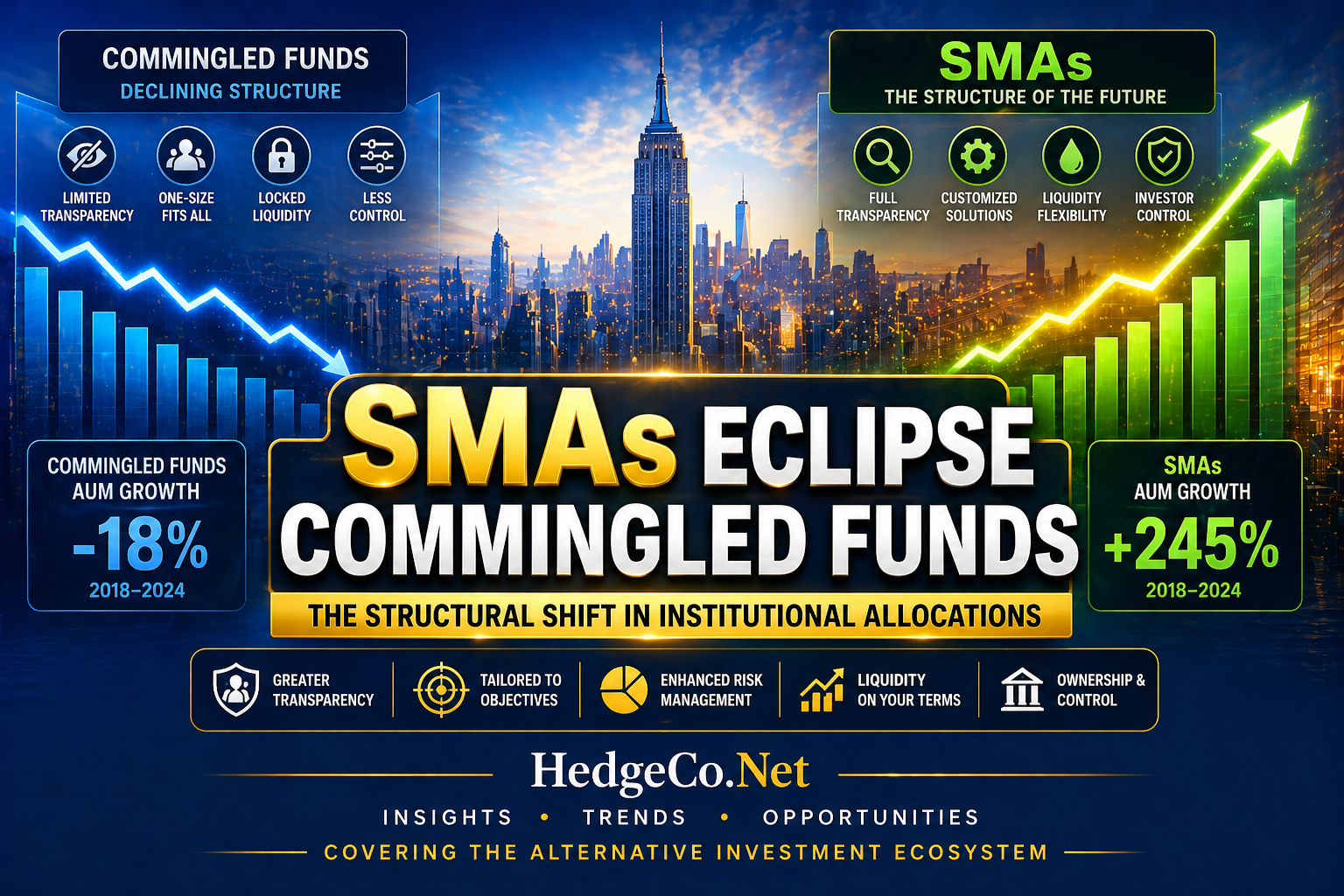
(HedgeCo.Net) A quiet but powerful transformation is reshaping the foundations of the hedge fund industry. Institutional investors—once the backbone of commingled fund structures—are increasingly pivoting toward separately managed accounts (SMAs), a trend that is rapidly gaining momentum across pensions, endowments, sovereign wealth funds, and large family offices.
At its core, this shift reflects a fundamental change in investor priorities. Transparency, control, and liquidity—once secondary considerations—have now become central pillars of portfolio construction. As a result, SMAs are no longer viewed as niche solutions for the largest allocators; they are emerging as the preferred structure for a growing share of institutional capital.
For hedge funds, particularly smaller and mid-sized managers, the implications are profound.
Understanding the SMA Advantage
Separately managed accounts differ from traditional commingled funds in one critical respect: ownership and control.
In a commingled fund, investors pool their capital into a single vehicle managed by the fund manager. The manager makes investment decisions on behalf of all investors, who share in the fund’s performance. While this structure offers efficiency and access, it provides limited transparency and customization.
SMAs, by contrast, are bespoke investment accounts owned by a single investor but managed by an external manager. The assets remain in the investor’s name, and the investor retains significant oversight of the portfolio.
This structure offers several key advantages:
- Full Transparency: Investors can see every position, trade, and exposure in real time.
- Customization: Portfolios can be tailored to specific risk tolerances, regulatory constraints, or ESG preferences.
- Liquidity Control: Investors can define liquidity terms, avoiding the gating and redemption restrictions often associated with commingled funds.
- Risk Oversight: Direct ownership allows for more granular risk management and reporting.
In an era defined by uncertainty and heightened scrutiny, these features are proving increasingly attractive.
The Post-Crisis Legacy
The roots of the SMA trend can be traced back to the global financial crisis of 2008, when many hedge funds imposed gates and suspended redemptions. Investors who believed they had access to their capital discovered that liquidity could vanish precisely when it was needed most.
This experience left a lasting impression.
In the years that followed, institutional investors began to demand greater control over their assets. SMAs emerged as a natural solution, offering a way to retain the expertise of external managers while maintaining ownership and oversight.
The trend has only accelerated in recent years, driven by additional factors such as market volatility, regulatory changes, and advances in technology.
Technology as an Enabler
One of the key drivers of SMA adoption has been the evolution of technology.
Managing a separately managed account requires robust infrastructure, including trade execution systems, risk analytics, reporting tools, and compliance frameworks. Historically, these capabilities were expensive and difficult to scale, limiting SMAs to the largest institutions.
Today, that is no longer the case.
Advances in cloud computing, data analytics, and portfolio management systems have significantly reduced the cost and complexity of operating SMAs. Platforms can now support multiple managers, strategies, and asset classes within a single framework.
This technological evolution has democratized access to SMAs, allowing a broader range of investors to adopt the structure.
Institutional Demand Intensifies
The shift toward SMAs is being driven primarily by institutional investors, who are increasingly focused on risk management and governance.
Pension funds, in particular, have been at the forefront of this trend. With long-term liabilities and a need for stable returns, these institutions are prioritizing transparency and control over simplicity.
Endowments and sovereign wealth funds are following suit, seeking to align their portfolios with broader strategic objectives, including sustainability and geopolitical considerations.
Family offices, too, are embracing SMAs as they professionalize their investment operations and seek greater oversight.
Across all these segments, the message is consistent: investors want to know exactly what they own, how it is being managed, and what risks they are taking.
Pressure on Hedge Fund Managers
For hedge fund managers, the rise of SMAs presents both an opportunity and a challenge.
On one hand, SMAs offer access to large, stable pools of capital. Winning an SMA mandate from a major institution can provide a significant boost to assets under management and enhance a firm’s credibility.
On the other hand, the operational demands of managing SMAs are substantial.
Unlike commingled funds, where a single portfolio can serve multiple investors, SMAs require customization at the account level. This includes tailored portfolios, reporting, compliance, and risk management.
For large, well-resourced firms, these requirements are manageable. For smaller managers, they can be prohibitive.
The Operational Burden
Running an SMA platform is resource-intensive.
Managers must invest in:
- Technology Infrastructure: Systems for trading, risk management, and reporting
- Compliance and Legal Support: Ensuring adherence to regulatory requirements and client mandates
- Operations and Middle Office: Handling trade settlements, reconciliations, and account maintenance
- Client Service: Providing detailed reporting and communication to investors
These costs can erode margins, particularly for firms without significant scale.
As a result, many smaller managers face a difficult choice: invest heavily in infrastructure to compete for SMA mandates or risk being excluded from a growing segment of the market.
The Role of Platforms and Outsourcing
To address these challenges, a new ecosystem of service providers has emerged.
Platform providers offer turnkey solutions that enable managers to operate SMAs without building infrastructure from scratch. These platforms handle trading, reporting, compliance, and other functions, allowing managers to focus on investment performance.
Outsourcing has become a critical tool in this context. By leveraging third-party providers, managers can access institutional-grade capabilities at a fraction of the cost.
However, outsourcing also introduces dependencies and requires careful oversight to ensure alignment with client expectations.
Fee Compression and Alignment
Another significant implication of the SMA shift is its impact on fees.
Commingled funds have traditionally operated on a “2 and 20” model—charging a 2% management fee and a 20% performance fee. SMAs, by contrast, often involve more negotiated fee structures, reflecting the customized nature of the relationship.
Investors are increasingly demanding lower management fees, higher hurdles for performance fees, and greater alignment of interests.
This trend is contributing to broader fee compression across the industry, particularly for managers who lack strong track records or differentiated strategies.
Transparency and Trust
At its core, the move toward SMAs is about trust.
In a commingled fund, investors must rely on the manager’s reporting and disclosures. While these have improved over time, they still involve a degree of opacity.
SMAs eliminate much of this uncertainty. By owning the assets directly, investors gain full visibility into the portfolio.
This transparency can strengthen relationships between managers and investors, fostering a more collaborative dynamic. However, it also increases accountability, as managers are subject to greater scrutiny.
The Impact on Industry Structure
The rise of SMAs is contributing to a broader restructuring of the hedge fund industry.
Large, multi-strategy platforms—such as Citadel, Millennium Management, and Point72 Asset Management—are well-positioned to capitalize on this trend. Their scale and infrastructure allow them to manage multiple SMA mandates efficiently.
Mid-sized managers face a more complex landscape. Those with strong performance and institutional relationships may succeed, but others may struggle to adapt.
Smaller firms, in particular, are at risk of being squeezed out, as they lack the resources to meet institutional demands.
This dynamic is likely to accelerate consolidation within the industry.
Opportunities for Differentiation
Despite the challenges, the shift toward SMAs also creates opportunities.
Managers who can offer:
- Specialized Expertise: Niche strategies that cannot be easily replicated
- Strong Performance: Consistent alpha generation
- Operational Excellence: Robust systems and processes
- Client Alignment: Transparent and flexible structures
will be well-positioned to attract SMA mandates.
In this sense, the trend may ultimately reward quality over scale.
Risks and Considerations
While SMAs offer many benefits, they are not without risks.
Operational Complexity: Managing multiple customized accounts can strain resources.
Liquidity Mismatches: While SMAs offer greater control, underlying assets may still be illiquid.
Concentration Risk: Large SMA mandates can create dependency on a small number of clients.
Regulatory Challenges: Increased transparency can lead to greater regulatory scrutiny.
Investors and managers alike must navigate these risks carefully.
The Future of SMAs
Looking ahead, the growth of SMAs appears set to continue.
Several trends are likely to shape their evolution:
- Integration with Technology: Further automation and analytics will enhance efficiency
- Expansion into New Asset Classes: SMAs will extend beyond equities and credit into private markets
- Greater Standardization: Industry frameworks may emerge to streamline operations
- Increased Competition: More managers will seek to enter the SMA space
As these developments unfold, SMAs are likely to become an even more central component of institutional portfolios.
Conclusion
The rise of separately managed accounts represents a fundamental shift in how capital is allocated within the hedge fund industry.
Driven by demands for transparency, control, and liquidity, SMAs are rapidly eclipsing traditional commingled fund structures. For investors, they offer a more tailored and transparent approach to portfolio management. For managers, they present both a challenge and an opportunity.
As the industry adapts to this new reality, one thing is clear: the balance of power is shifting toward investors. And in this new landscape, those who can meet the demands of transparency and customization will define the future of hedge fund investing.