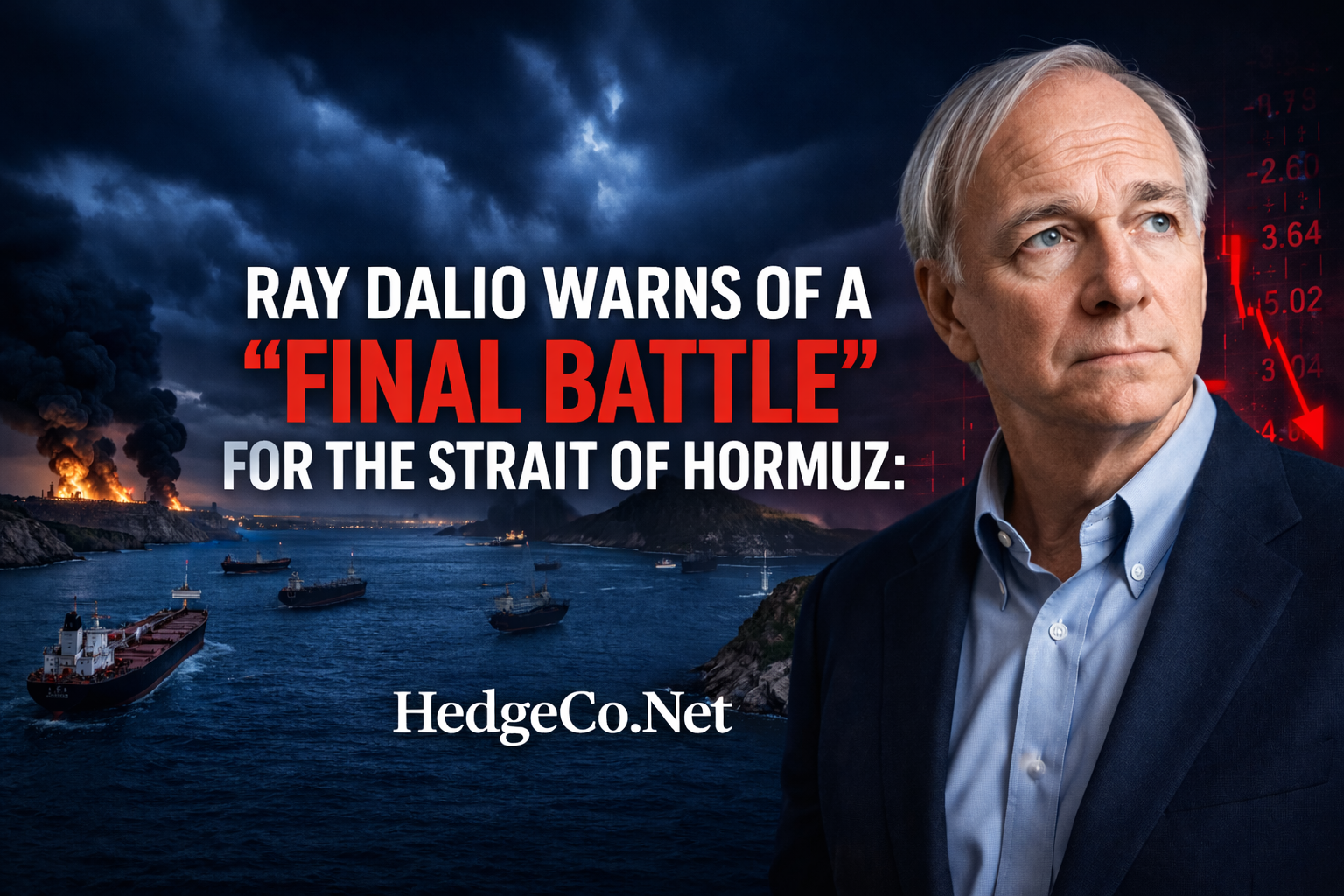
(HedgeCo.Net) In a series of stark public warnings that have captured the attention of both policymakers and investors, Ray Dalio has framed the escalating tensions in the Middle East—particularly around the Strait of Hormuz—as a potential “final battle” with far-reaching implications for the global financial system. The founder of Bridgewater Associates, the world’s largest hedge fund, has argued that the current moment represents not just a geopolitical flashpoint, but a structural inflection point that could redefine energy markets, global trade flows, and even the long-standing dominance of the U.S. dollar.
Dalio’s characterization of the situation as a modern-day “Suez moment” is not hyperbole. It is a deliberate invocation of history—one that signals the possibility of a systemic shock capable of reshaping the global order. For institutional investors, hedge funds, and policymakers alike, the message is clear: the intersection of geopolitics and markets has entered a new and more volatile phase.
The Strait of Hormuz: The World’s Most Critical Energy Chokepoint
To understand the gravity of Dalio’s warning, one must first appreciate the strategic importance of the Strait of Hormuz.
This narrow waterway, located between Iran and Oman, serves as the primary conduit for roughly 20% of the world’s oil supply. Every day, millions of barrels of crude oil pass through this chokepoint, making it one of the most vital arteries of the global economy.
Any disruption—whether through military conflict, blockade, or even heightened tensions—has immediate and profound implications:
- Sharp spikes in oil prices
- Disruptions to global supply chains
- Increased inflationary pressure across economies
- Heightened volatility in financial markets
In many ways, the Strait of Hormuz is not just a geographic feature—it is a fulcrum upon which the modern global economy balances.
Dalio’s Framework: Cycles, Conflict, and Systemic Change
Ray Dalio is known for his long-term, cycle-based approach to understanding markets and geopolitics. His framework emphasizes the interplay between economic cycles, political dynamics, and shifts in global power.
Within this context, his warning about the Strait of Hormuz is part of a broader thesis: that the world is entering a late-stage phase of a long-term debt and geopolitical cycle.
Key elements of this framework include:
- High levels of global debt
- Rising geopolitical tensions between major powers
- Increasing fragmentation of global trade systems
- Challenges to the existing monetary order
In Dalio’s view, these forces are converging in a way that makes systemic disruption more likely.
The “Suez Moment” Analogy
Dalio’s reference to the Suez Crisis of 1956 is particularly instructive.
During that crisis, Egypt’s nationalization of the Suez Canal triggered a military response from the United Kingdom, France, and Israel. The ensuing conflict not only disrupted global trade but also marked a turning point in the decline of European colonial influence and the rise of the United States as the dominant global power.
By invoking this analogy, Dalio is suggesting that the current tensions in the Strait of Hormuz could have similarly transformative effects.
Potential parallels include:
- A shift in the balance of global power
- A reconfiguration of energy trade routes
- Increased involvement of major powers, including the United States and China
- Long-term changes in the structure of global markets
Oil, Inflation, and the Market Feedback Loop
One of the most immediate impacts of rising tensions in the Strait of Hormuz is the effect on oil prices.
Energy markets are highly sensitive to geopolitical risk, and even the perception of potential disruption can drive significant price movements. In recent weeks, concerns about the security of the Strait have already contributed to increased volatility in oil markets.
This has broader implications for the global economy:
- Higher energy costs feed directly into inflation
- Central banks may be forced to maintain or increase interest rates
- Economic growth could slow as consumer and business costs rise
For financial markets, this creates a complex feedback loop. Rising inflation expectations can lead to higher bond yields, which in turn affect equity valuations and capital flows.
Implications for the U.S. Dollar and Global Monetary Order
Perhaps the most provocative aspect of Dalio’s warning is its implication for the U.S. dollar.
For decades, the dollar has served as the world’s primary reserve currency, underpinning global trade and financial systems. This dominance has been supported by:
- The size and stability of the U.S. economy
- The depth of U.S. financial markets
- The central role of the dollar in energy transactions
However, disruptions in the Strait of Hormuz could accelerate trends that challenge this dominance.
For example:
- Countries may seek alternative payment systems to reduce reliance on the dollar
- Energy producers and consumers could explore pricing oil in other currencies
- Geopolitical alliances may shift in ways that weaken the dollar’s central role
While such changes would not happen overnight, the trajectory could be set in motion by a major geopolitical shock.
Hedge Funds and the New Macro Regime
For hedge funds, Dalio’s warning underscores the importance of adapting to a new macro regime.
Traditional models that focus primarily on economic data and central bank policy may be insufficient in an environment where geopolitical factors play an increasingly dominant role.
This shift has several implications:
- Greater emphasis on geopolitical analysis
- Increased demand for real-time intelligence and data
- More dynamic risk management approaches
- Opportunities for alpha generation through macro trading
Firms like Bridgewater Associates, with their global macro focus, may be particularly well-positioned to navigate this environment.
The Role of the United States: Strategic and Economic Considerations
The United States has long maintained a strategic interest in ensuring the security of the Strait of Hormuz. Any threat to this chokepoint is likely to prompt a response, both to protect global energy flows and to maintain geopolitical influence.
However, the situation is increasingly complex:
- The U.S. is now a major energy producer, reducing its direct dependence on Middle Eastern oil
- Domestic political considerations may influence foreign policy decisions
- Rival powers, particularly China, have growing interests in the region
These factors create a delicate balancing act for policymakers.
China and the Multipolar World
China’s role in this dynamic cannot be overlooked.
As the world’s largest importer of oil, China has a significant stake in the stability of the Strait of Hormuz. At the same time, it has been actively working to expand its influence in the Middle East through economic and diplomatic initiatives.
In a scenario where tensions escalate, China could:
- Increase its involvement in regional security
- Strengthen ties with key energy producers
- Accelerate efforts to develop alternative trade routes
This would further reinforce the shift toward a more multipolar global order—a key element of Dalio’s long-term thesis.
Market Scenarios: From Volatility to Structural Change
From an investment perspective, the situation presents a range of potential scenarios.
Short-Term Volatility
In the immediate term, markets are likely to experience increased volatility, particularly in energy, commodities, and fixed income.
Medium-Term Adjustment
Over time, markets may adjust to new realities, with shifts in pricing, supply chains, and investment flows.
Long-Term Transformation
In the most extreme scenario, a prolonged disruption could lead to structural changes in the global economy, including:
- Reconfiguration of energy markets
- Changes in currency dynamics
- New geopolitical alliances
Risk Management in an Uncertain World
For institutional investors, the key challenge is managing risk in an environment characterized by uncertainty and rapid change.
This requires:
- Diversification across asset classes and geographies
- Flexible investment strategies
- Continuous monitoring of geopolitical developments
- Scenario planning and stress testing
The goal is not to predict the future with certainty, but to build resilience against a range of possible outcomes.
Dalio’s Track Record: Why the Market Is Listening
Ray Dalio is not the first to warn of geopolitical risks, but his track record lends weight to his analysis.
Over the years, Dalio has been early in identifying major trends, including:
- The rise of China as a global power
- The long-term debt cycle in developed economies
- The increasing role of monetary policy in markets
While not all of his predictions have materialized as expected, his framework has proven influential among investors and policymakers.
Conclusion: A Defining Moment for Markets and Geopolitics
Ray Dalio’s warning about a “final battle” for the Strait of Hormuz is more than a commentary on current events—it is a call to recognize the broader forces shaping the global economy.
At stake is not just the flow of oil, but the stability of the financial system, the structure of global trade, and the future of the dollar as the world’s reserve currency.
For investors, the message is clear:
- Geopolitics can no longer be treated as a secondary consideration
- Risk management must evolve to reflect new realities
- Opportunities will emerge for those able to navigate complexity
Whether or not the current tensions escalate into a full-scale crisis, the underlying trends identified by Dalio are unlikely to reverse.
We are entering a new era—one defined by uncertainty, competition, and transformation.
And in that era, the Strait of Hormuz may prove to be not just a geographic chokepoint, but a turning point in the history of global markets.