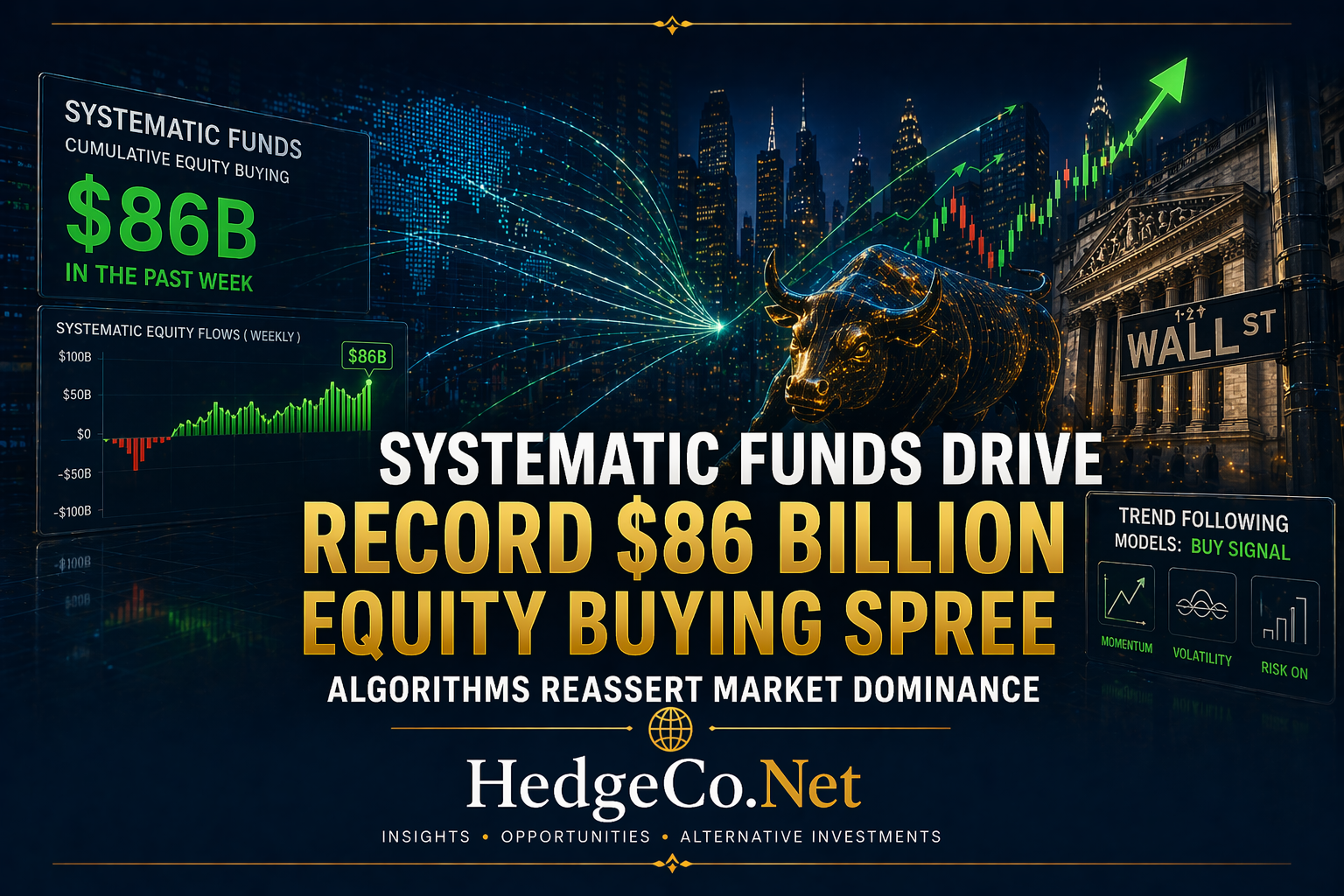
(HedgeCo.Net) In a striking display of the growing influence of quantitative investing, systematic and trend-following strategies have injected an estimated $86 billion into global equities over the past week—one of the largest short-term buying waves in recent memory. The surge, fueled by a combination of technical breakouts, declining volatility, and improving macro sentiment, underscores the extent to which algorithmic models now shape market direction, often amplifying trends with a speed and scale that traditional discretionary investors struggle to match.
The magnitude of the move has caught the attention of institutional investors, policymakers, and market participants alike. At a time when geopolitical uncertainty remains elevated and economic signals are mixed, the sheer force of systematic capital flows is acting as a powerful counterweight, driving equities higher and compressing risk premiums across asset classes. For many, the episode serves as a reminder that modern markets are no longer driven solely by fundamentals, but increasingly by the mechanics of positioning, signals, and automated execution.
The Rise of Systematic Capital
Systematic funds—often referred to as quant funds, CTA (Commodity Trading Advisor) strategies, or trend-following programs—operate on rules-based models that analyze price trends, volatility, and other quantitative signals to determine asset allocation. Unlike discretionary managers, who rely on fundamental analysis and judgment, systematic strategies execute trades based on predefined algorithms, allowing for rapid and consistent decision-making.
Over the past two decades, these strategies have grown from niche allocations into a dominant force within global markets. Firms such as AQR Capital Management, Man Group, and Winton Group have expanded their assets under management significantly, attracting capital from institutional investors seeking diversification and uncorrelated returns.
The appeal of systematic strategies lies in their ability to remove emotional bias and exploit persistent market inefficiencies. By relying on data-driven models, these funds can identify trends and execute trades with a level of precision that is difficult to replicate through discretionary approaches.
Anatomy of the $86 Billion Surge
The recent $86 billion buying spree did not occur in isolation but was the result of several converging factors. Chief among them was a series of technical breakouts across major equity indices. As markets pushed through key resistance levels, trend-following models generated buy signals, triggering a wave of inflows into equities.
At the same time, volatility metrics—such as the VIX—began to decline, creating a more favorable environment for risk-taking. Many systematic strategies incorporate volatility as a key input, adjusting their exposure based on perceived risk levels. As volatility falls, these models typically increase their allocations to equities, further reinforcing upward momentum.
Geopolitical developments also played a role. The easing of tensions in the Middle East, particularly surrounding the Iran conflict, contributed to improved risk sentiment, encouraging both discretionary and systematic investors to re-engage with markets. However, the scale of the systematic response far outpaced that of traditional participants, highlighting the outsized influence of algorithmic flows.
Feedback Loops and Market Amplification
One of the defining characteristics of systematic investing is its tendency to create feedback loops. As prices rise and trends strengthen, models generate additional buy signals, leading to further inflows and higher prices. This self-reinforcing dynamic can accelerate market movements, particularly in environments where liquidity is abundant and resistance levels are breached.
The recent equity rally provides a textbook example of this phenomenon. Initial gains triggered systematic buying, which in turn pushed prices higher, attracting additional capital and reinforcing the trend. The result was a rapid and sustained move that exceeded what might have been expected based on fundamentals alone.
While such dynamics can create opportunities for investors, they also introduce risks. Feedback loops can operate in both directions, meaning that a reversal in trend could trigger equally rapid selling. Understanding the mechanics of these flows is therefore critical for navigating modern markets.
The Role of Volatility Targeting
Volatility-targeting strategies have been a key driver of the recent buying activity. These strategies adjust their exposure to equities based on observed or expected volatility, increasing allocations when markets are calm and reducing them when volatility rises.
In the current environment, declining volatility has allowed these strategies to ramp up their equity exposure significantly. The effect is magnified by the size of assets managed under volatility-targeting frameworks, which collectively represent hundreds of billions of dollars.
This dynamic creates a powerful tailwind for equities during periods of stability. However, it also raises the potential for abrupt shifts if volatility spikes. A sudden increase in volatility could force these strategies to deleverage, leading to rapid outflows and downward pressure on prices.
Interaction with Discretionary Investors
The dominance of systematic flows has important implications for discretionary investors, including traditional hedge funds and asset managers. In many cases, discretionary managers find themselves reacting to market movements driven by algorithms rather than initiating them.
This shift has altered the competitive landscape, requiring discretionary investors to adapt their strategies. Some have incorporated quantitative elements into their processes, while others focus on identifying opportunities created by systematic flows, such as temporary mispricings or liquidity dislocations.
The interplay between systematic and discretionary investors can create complex market dynamics. At times, the two groups may reinforce each other, while in other instances they may act in opposition, leading to increased volatility.
Liquidity and Market Structure
The impact of systematic flows is closely tied to the structure of modern markets. Advances in technology, including high-frequency trading and electronic execution platforms, have increased the speed and efficiency of trading. However, they have also contributed to a more fragmented and sometimes fragile liquidity environment.
In such a landscape, large flows—whether from systematic funds or other sources—can have an outsized impact on prices. The $86 billion equity buying spree is a case in point, demonstrating how concentrated flows can drive significant market movements in a relatively short period.
Market participants must therefore be mindful of liquidity conditions, particularly during periods of stress. While systematic strategies can provide liquidity during stable conditions, they may withdraw it during periods of volatility, exacerbating market swings.
Broader Implications for Asset Allocation
The rise of systematic investing has broader implications for asset allocation and portfolio construction. As these strategies become more influential, their behavior must be considered alongside traditional factors such as fundamentals and macroeconomic trends.
For institutional investors, this means understanding how systematic flows interact with their portfolios. Allocations to equities, fixed income, and alternative assets may be influenced not only by economic conditions but also by the positioning and behavior of quantitative strategies.
Some investors have responded by increasing their exposure to systematic funds, viewing them as a complementary source of returns. Others focus on diversification, seeking to mitigate the impact of potential feedback loops and volatility spikes.
Risks and Potential Reversals
Despite the positive momentum generated by the recent buying spree, risks remain. The reliance on technical signals means that systematic strategies can be sensitive to changes in market conditions. A break below key support levels or a spike in volatility could trigger a reversal of flows, leading to rapid selling.
Additionally, the concentration of assets within similar strategies raises concerns about crowding. If multiple funds are positioned in the same direction, the unwinding of those positions could amplify market movements, creating a cascade effect.
Regulatory scrutiny is another potential factor. As the influence of systematic investing grows, regulators may seek to understand and, if necessary, mitigate the risks associated with large, coordinated flows.
Outlook: A Market Defined by Algorithms
Looking ahead, it is clear that systematic strategies will continue to play a central role in shaping market dynamics. Advances in data analytics, machine learning, and computing power are likely to enhance the capabilities of these models, further increasing their influence.
At the same time, the interaction between systematic and discretionary investors will remain a key driver of market behavior. Understanding this interplay will be essential for navigating an environment where traditional assumptions about price discovery and market efficiency are being challenged.
The recent $86 billion buying spree may be an extreme example, but it is indicative of a broader trend. Markets are becoming more responsive to signals and flows, and less anchored to traditional valuation metrics.
Conclusion: The New Market Reality
The record-breaking equity buying driven by systematic funds marks a defining moment in the evolution of global markets. It highlights the growing dominance of algorithmic strategies and their ability to move markets with unprecedented speed and scale.
For investors, the implications are profound. Success in this environment requires not only an understanding of fundamentals but also a deep appreciation of market mechanics, positioning, and flow dynamics. The ability to anticipate and respond to systematic activity may prove to be a critical differentiator.
As the lines between human and machine-driven investing continue to blur, one thing is certain: the future of markets will be shaped as much by algorithms as by analysis. And in that future, the influence of systematic funds is likely to grow, redefining how capital is deployed and how markets behave.