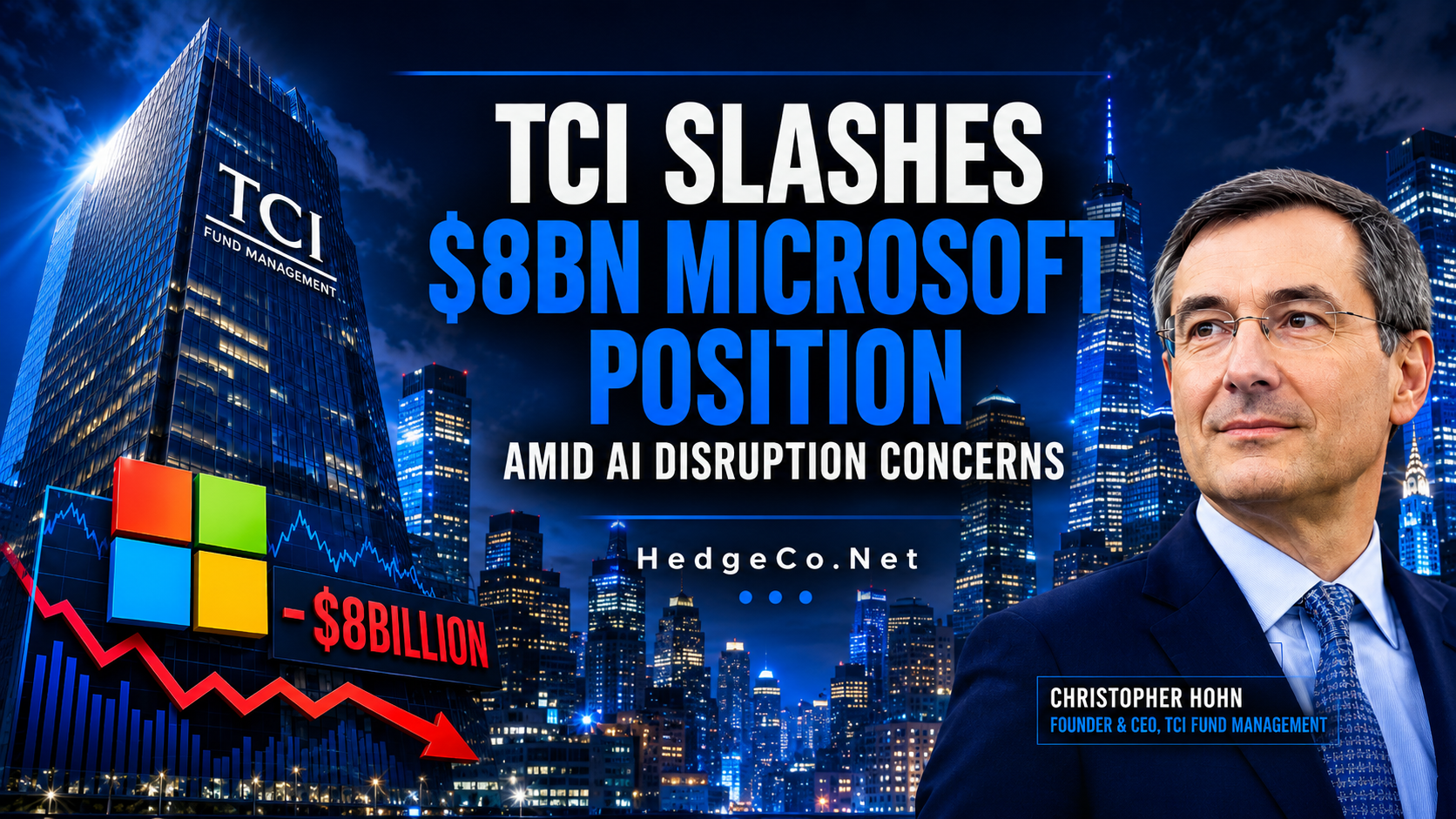
(HedgeCo.Net) Sir Christopher Hohn’s TCI Fund Management has sharply reduced its long-standing Microsoft position, marking one of the clearest signals yet that even the world’s most successful concentrated hedge fund investors are beginning to separate artificial intelligence winners from artificial intelligence incumbents.
According to the Financial Times, TCI cut its Microsoft exposure from roughly 10% of the portfolio to about 1% by the end of March 2026, effectively slashing an approximately $8 billion position after nearly a decade of strong gains. In a letter to investors, Hohn reportedly pointed to concerns that rapid advances in artificial intelligence could disrupt Microsoft’s core software franchises, including Office and Azure.
For the alternative investment industry, the move is significant for reasons that go well beyond Microsoft. TCI is not a short-term trading shop chasing headlines. It is a long-term, concentrated, fundamental hedge fund known for holding high-quality global businesses, engaging with management, and allowing compounding to work over multi-year periods. TCI describes itself as a value-oriented fundamental investor focused on strong businesses with sustainable competitive advantages.
That makes the Microsoft sale especially notable. This is not simply a hedge fund rotating out of a crowded technology trade after a strong run. It is a prominent investor questioning whether artificial intelligence may weaken the moat of one of the most dominant enterprise software companies in the world.
For years, Microsoft has been treated by global investors as one of the safest ways to own the artificial intelligence theme. Its partnership with OpenAI, its massive Azure cloud platform, its enterprise software dominance, and its embedded relationships with corporations made it one of the first mega-cap beneficiaries of the AI boom. But Hohn’s reported position cut suggests a more complicated institutional debate is emerging: AI may help Microsoft, but it may also threaten the economics of the very businesses that made Microsoft indispensable.
That distinction matters. The first phase of the AI trade rewarded companies with scale, compute access, cloud infrastructure, enterprise relationships, and exposure to generative AI adoption. Microsoft checked all of those boxes. The second phase may be less forgiving. Investors are now asking whether AI creates durable new revenue streams, compresses margins, commoditizes software, changes customer behavior, or enables a new generation of competitors to attack entrenched platforms.
TCI’s move reflects that shift.
Microsoft has long been a model of enterprise software durability. Office, Windows, Azure, LinkedIn, GitHub, Dynamics, Teams, and a broad universe of productivity and developer tools have made the company one of the most deeply embedded technology vendors in corporate life. Its products are not simply purchased; they are integrated into workflows, compliance systems, identity architecture, document management, collaboration, cybersecurity, and IT procurement.
That embedded position created one of the strongest moats in global technology. The Microsoft ecosystem has historically benefited from switching costs, network effects, bundled distribution, enterprise trust, and a broad developer base. For a hedge fund like TCI, those traits are attractive because they resemble the qualities investors look for in compounding businesses: pricing power, recurring revenue, high customer retention, large addressable markets, and strong free cash flow.
The concern now is whether AI changes the nature of that moat.
Generative AI has the potential to alter how people interact with software. Instead of navigating applications, users may increasingly ask AI agents to perform tasks across applications. Instead of building workflows around specific software suites, companies may build workflows around intelligent assistants. Instead of treating a productivity suite as the center of corporate work, enterprises may treat AI orchestration as the new control layer.
If that happens, Microsoft’s existing distribution power remains valuable, but it may not be enough. The risk is that AI shifts the point of customer loyalty away from the traditional application layer and toward the model, agent, data, or workflow automation layer. In plain terms, the software interface that dominated enterprise computing for decades may become less important if AI becomes the interface.
That is the disruption question behind TCI’s reported move.
The market has already begun to wrestle with this issue. Microsoft has spent heavily to position itself at the center of artificial intelligence adoption, embedding Copilot across Office, Windows, developer tools, and enterprise workflows. But investors increasingly want proof that AI features can generate sufficient incremental revenue to justify the infrastructure spending required to deliver them at scale. The Financial Times report noted that Microsoft shares had fallen in 2026 amid questions about AI monetization and the impact of AI on Microsoft’s core businesses.
The Microsoft debate now sits at the intersection of three major investment questions.
First, can the company monetize AI at attractive margins? AI products require expensive infrastructure, including data centers, chips, power, networking, and ongoing model-related costs. If customers adopt AI tools but resist paying enough to offset those costs, the revenue growth may not translate into the kind of margin expansion investors expect from software companies.
Second, can Microsoft defend its productivity franchise if AI lowers the importance of traditional applications? Office has been one of the most durable software franchises in history. But if AI agents can generate documents, analyze spreadsheets, summarize communications, build presentations, and manage workflows across competing platforms, the value of individual applications could change.
Third, can Microsoft protect Azure’s economics as AI reshapes the cloud market? Azure has been a major pillar of Microsoft’s growth story. But AI infrastructure is capital intensive, competitive, and increasingly tied to access to chips, energy, and specialized hardware. The cloud market may remain enormous, but the economics of AI cloud growth may not mirror the high-margin software model that investors have historically associated with Microsoft.
For hedge funds, this is exactly the kind of debate that defines the next stage of technology investing. The broad “AI winners” basket is giving way to a more selective framework. Managers are asking which companies are true beneficiaries, which are simply spending aggressively to keep up, and which incumbents may face disruption from the very technology they are deploying.
TCI’s reported Microsoft cut shows how quickly the AI investment narrative can evolve.
Only a few years ago, Microsoft’s OpenAI exposure was widely viewed as a strategic masterstroke. It gave Microsoft early access to one of the most important AI platforms in the world and allowed the company to move faster than many of its mega-cap peers. The company became the default institutional way to own enterprise AI adoption without taking private-market venture risk.
But the more AI matures, the more investors are distinguishing between narrative leadership and economic capture. A company can be central to the AI story and still face pressure if monetization disappoints, capital intensity rises, or competitive dynamics shift. In that sense, Microsoft may be both a winner and a company under threat.
That paradox is what makes the TCI move so compelling.
Hohn is not rejecting artificial intelligence as a theme. Rather, the reported decision suggests TCI is questioning how AI changes the durability of Microsoft’s cash flows. The distinction is crucial. A hedge fund can be bullish on AI adoption while bearish on certain incumbents if the technology compresses margins or undermines legacy profit pools.
The Financial Times reported that TCI increased its Alphabet position from 3% to 5%, making Alphabet its largest technology holding. That detail is important because it suggests a rotation within technology rather than a retreat from the sector altogether. Alphabet also faces AI disruption risk, particularly in search, but it owns world-class AI research, massive consumer distribution, cloud infrastructure, YouTube, Android, and enormous data assets. TCI’s relative preference may indicate that it sees Alphabet’s valuation, AI positioning, or business mix as more compelling than Microsoft’s at this stage of the cycle.
For alternative investment managers, this type of rotation is likely to become more common. The AI trade is no longer just about identifying companies that mention AI, invest in AI, or partner with AI leaders. It is about underwriting how AI changes industry structure.
That underwriting process is especially important for concentrated managers. A diversified index investor can own Microsoft, Alphabet, Amazon, Meta, Nvidia, and other AI-linked companies and allow the basket to sort itself out over time. A concentrated hedge fund does not have that luxury. It must decide where the best risk-adjusted return exists and where the downside to the thesis has become too large.
TCI has built its reputation on large, high-conviction positions in businesses it believes can compound over long periods. The decision to reduce Microsoft so dramatically suggests the fund sees the risk-reward profile as having changed. That does not mean Microsoft is broken. It does mean one of the world’s most closely watched hedge fund investors appears to believe the market may be underestimating the disruption risk created by AI.
The broader implication for hedge funds is that the mega-cap technology trade is becoming less uniform. During much of the AI boom, large-cap technology stocks moved as a group, fueled by expectations that the biggest platforms would capture the most value. Now dispersion may increase. Some incumbents may strengthen their positions. Others may face margin pressure. Some may require higher capital spending to defend existing franchises. Others may convert AI into high-margin incremental revenue.
That creates opportunity for hedge funds.
Long/short equity managers thrive when dispersion rises. If AI causes the market to reprice winners and losers within the same sector, hedge funds can express more nuanced views than long-only investors. They can go long companies with durable AI monetization and short companies whose profit pools may be threatened. They can rotate among mega-cap platforms, semiconductor suppliers, cloud providers, software vendors, data-center infrastructure firms, and power-generation companies.
The TCI-Microsoft story also connects directly to a larger theme now running through alternative investments: AI is not just a venture capital story or a public-equity growth story. It is now affecting hedge fund positioning, private equity underwriting, infrastructure capital allocation, power markets, credit analysis, and corporate M&A.
AI is forcing investors to revisit assumptions across the capital stack. Software businesses once considered nearly unassailable may face new competitive threats. Infrastructure assets tied to data centers may become more valuable. Power generation and grid reliability may become central to digital growth. Private equity firms may have to reassess portfolio-company technology risk. Credit investors may need to evaluate whether borrowers are vulnerable to AI-driven margin pressure or automation.
In that context, Microsoft is more than a single stock. It is a test case for whether incumbency remains enough in the AI era.
The company still has formidable strengths. Microsoft’s enterprise relationships are deep. Its balance sheet is powerful. Its product ecosystem is broad. Its AI distribution channels are significant. Azure remains one of the world’s leading cloud platforms. Copilot gives the company a direct path to embedding AI into daily corporate work. And Microsoft’s long history of adapting to new technology cycles should not be dismissed.
But the market is no longer rewarding AI exposure without scrutiny. Investors want to see whether AI produces durable earnings growth, not just product announcements. They want to know whether customers are paying, whether margins hold, whether infrastructure investments earn acceptable returns, and whether new AI-native competitors can displace legacy software economics.
That is why the TCI decision resonates. It captures the moment when AI shifted from a valuation accelerator to a fundamental risk factor.
For years, Microsoft’s investment case was built on the idea that the company had successfully transformed itself from a legacy software provider into a cloud and subscription powerhouse. That transformation turned Microsoft into one of the most admired compounders in global markets. The AI era initially appeared to extend that story. Now investors are asking whether AI may instead begin a new cycle of disruption.
The answer is not obvious. Microsoft may prove that its distribution, customer trust, and integration capabilities allow it to monetize AI better than almost anyone else. If Copilot adoption accelerates, Azure AI demand remains strong, and enterprise customers deepen their reliance on Microsoft’s AI stack, the company could emerge even stronger.
But TCI’s reported reduction indicates that not all elite investors are willing to wait for that proof while the position remains large.
The move may also reflect valuation discipline. Microsoft’s scale, quality, and AI exposure made it a core holding for many institutional portfolios. When a stock becomes widely owned and heavily associated with a dominant theme, expectations can become demanding. If uncertainty rises around monetization, margin structure, or disruption risk, even a strong company can become a less attractive investment.
That is especially true for hedge funds measured on absolute performance. They are not required to own Microsoft because it is a benchmark heavyweight. They can reduce exposure when the thesis changes. They can reallocate capital to other companies, sectors, or themes where they see better asymmetry.
TCI’s portfolio construction also matters. The fund reportedly remains heavily weighted toward other sectors, with GE Aerospace described as its top holding and additional major positions in companies such as Visa, Moody’s, and Ferrovial. That mix suggests TCI continues to favor high-quality businesses with durable competitive positions, but it is reassessing which moats remain strongest in an AI-driven environment.
For Microsoft, the central question is not whether AI will matter. It obviously will. The question is whether Microsoft can capture more value from AI than it loses through disruption to legacy software economics.
That is a difficult equation. AI can expand the market for productivity tools by making workers more efficient. It can increase demand for cloud infrastructure. It can create new subscription revenue. It can improve developer productivity. It can automate business processes. All of these are positives for Microsoft.
At the same time, AI can lower barriers to entry for software creation. It can allow smaller companies to build products faster. It can make users less dependent on traditional software interfaces. It can reduce the perceived value of bundled productivity suites. It can shift pricing power toward model providers, chip suppliers, or AI-native workflow platforms. These are the risks TCI appears to be taking seriously.
The broader hedge fund community will be watching closely. If TCI’s move proves prescient, it could encourage other managers to reassess their mega-cap technology exposure. If Microsoft successfully demonstrates strong AI monetization, TCI’s reduction may look overly cautious. Either way, the trade will become part of a much larger debate over how concentrated managers should navigate the AI cycle.
That debate is only beginning.
The first stage of AI investing was about access. Investors wanted exposure to companies with the clearest links to generative AI. The second stage is about economics. Which companies can convert AI adoption into cash flow? Which companies face higher costs without proportional revenue? Which companies see their moats strengthened, and which see them eroded?
TCI’s Microsoft cut is important because it shows that elite investors are now asking the second-stage questions.
For HedgeCo.Net readers, the story highlights a crucial development in alternative investment strategy. Artificial intelligence is no longer simply a growth theme. It is becoming a due-diligence lens. Hedge funds, private equity firms, credit managers, and infrastructure investors are all being forced to evaluate how AI affects competitive advantage, capital intensity, pricing power, and long-term returns.
Microsoft remains one of the most powerful companies in the world. But the fact that a major hedge fund investor has reportedly reduced a multibillion-dollar position over AI disruption concerns is a reminder that no incumbent is immune from technological change.
The irony is striking. Microsoft helped bring generative AI into the enterprise mainstream. Yet the same technology that elevated its market narrative may now be forcing investors to question the durability of its core franchise.
That is the new AI investing playbook. The winners will not simply be the companies closest to the theme. They will be the companies that can turn artificial intelligence into durable economics without sacrificing the businesses that made them dominant in the first place.
For TCI, the conclusion appears to be that Microsoft’s risk-reward balance has changed. For the hedge fund industry, the message is broader: AI disruption is no longer theoretical, and even the strongest blue-chip technology positions are being re-underwritten in real time.