(HedgeCo.Net) For years, Microsoft occupied a rare place inside global hedge fund portfolios: a mega-cap technology company with the stability of an infrastructure utility, the margins of a software monopoly, the balance sheet of a fortress and the growth profile of a cloud-computing leader. It was not merely a technology stock. For many long-only funds, activist investors and concentrated hedge fund managers, Microsoft became one of the safest expressions of the enterprise software era.
That perception is now being tested.
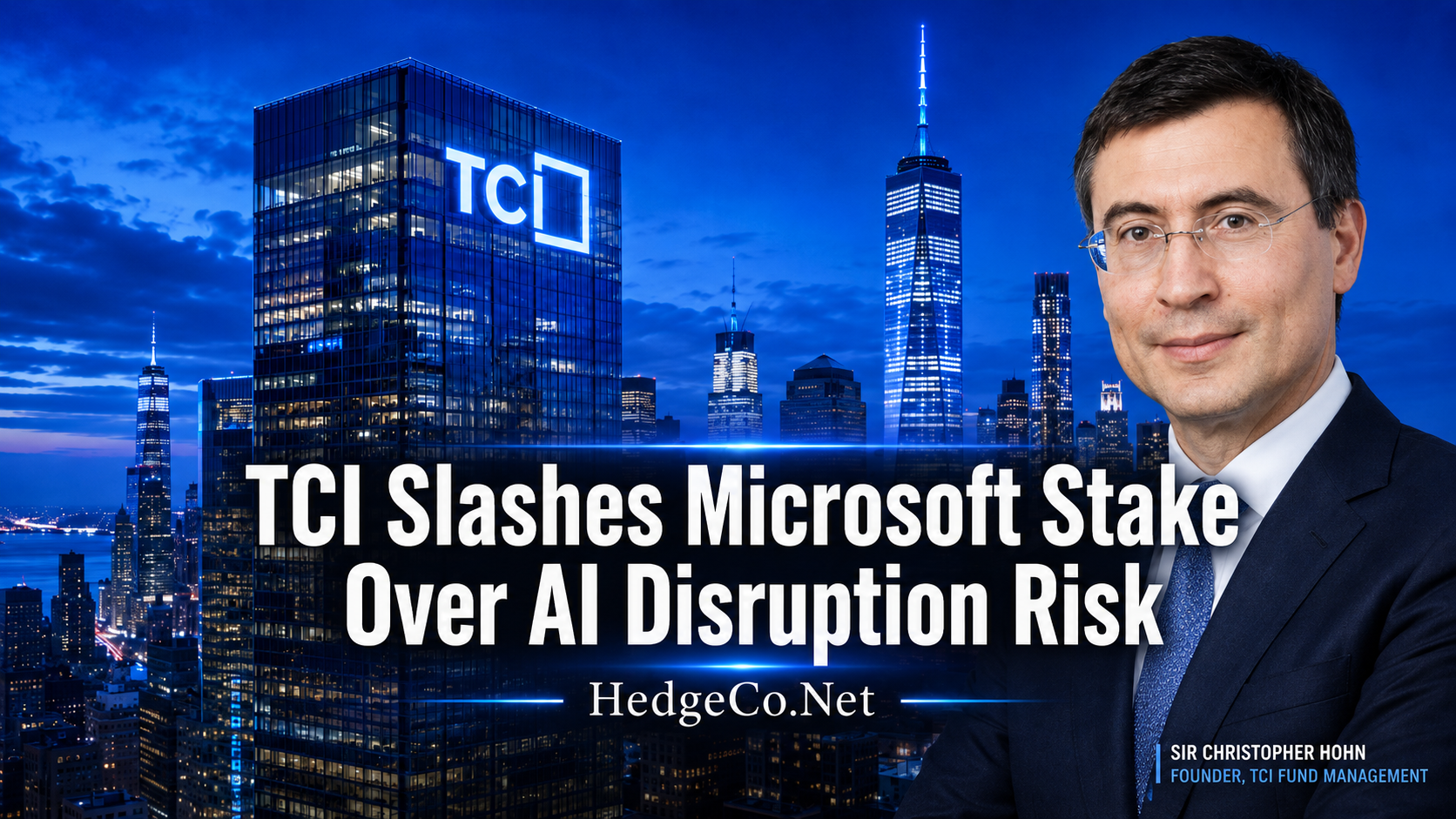
TCI Fund Management, the powerful hedge fund led by Sir Christopher Hohn, has sharply reduced its Microsoft position in what may become one of the most important hedge fund signals of the AI era. According to reporting from the Financial Times, TCI cut its stake in Microsoft from about 10% to just 1%, reducing a position that had been worth roughly $8 billion and warning investors that artificial intelligence could pose a threat to Microsoft’s dominant software franchises.
The move is striking not simply because of its size, but because of what it represents. Microsoft has spent the past several years being viewed as one of the biggest beneficiaries of the AI boom. Its early and deep partnership with OpenAI, its Azure cloud platform, its enterprise distribution network, and its Microsoft 365 Copilot strategy have all been central to the bull case that Microsoft could turn generative AI into a new software monetization engine. Yet TCI’s reduction reframes the debate. Instead of asking only how much Microsoft can earn from AI, investors are now asking how much AI could disrupt the very software economics that made Microsoft so valuable in the first place.
This is the new dividing line inside hedge fund technology investing. AI is no longer just a growth theme. It is becoming a disruption screen. The same technology that could expand Microsoft’s addressable market could also pressure its margins, raise capital intensity, accelerate competition and weaken the durability of legacy software moats.
For hedge funds, that changes everything.
Microsoft had been one of the cleanest examples of the “compounder” thesis: a company with recurring revenue, strong pricing power, huge switching costs, dominant enterprise relationships and deep cloud infrastructure. Those features made the stock attractive to concentrated managers who wanted quality, scale and defensibility. In a market increasingly driven by platform economics, Microsoft appeared to sit at the center of the enterprise technology stack.
But generative AI introduces a more complicated question. If AI agents can automate workflows across documents, spreadsheets, email, coding, customer service, analytics and enterprise resource planning, then the value chain of software could shift. The interface layer may become less tied to traditional applications. The user may care less about the software suite and more about the AI assistant that performs the task. If that happens, the pricing power embedded in legacy enterprise software could be more vulnerable than investors assumed.
That is the concern behind TCI’s move. The hedge fund is not necessarily saying Microsoft is a weak company. It is saying the market may be underestimating how AI changes the risk profile of the business. The difference matters. A company can be world-class and still face valuation compression if its future cash flows become harder to underwrite.
Microsoft’s defenders argue that the company remains one of the best-positioned players in artificial intelligence. Azure is a strategic cloud platform. Microsoft 365 gives the company access to hundreds of millions of enterprise users. GitHub Copilot has become an early example of AI productivity monetization. The OpenAI relationship gives Microsoft access to some of the most advanced models in the world. And because Microsoft already sits inside the enterprise workflow, it has a distribution advantage few competitors can match.
That is the bullish case. But the bearish case has become more sophisticated. AI infrastructure is expensive. Data centers, GPUs, networking equipment and power capacity require enormous capital spending. The leading technology platforms are spending aggressively to remain competitive, and investors are beginning to ask whether the returns on that spending will justify the scale of investment. Barron’s recently reported that Microsoft has been expanding aggressively in AI while facing investor scrutiny over AI capital expenditures, technological obsolescence and competition, even as Azure growth remains strong.
The market is now confronting a tension at the heart of the AI trade: the winners may not be the same companies that spend the most. In earlier phases of the technology cycle, software companies benefited from asset-light economics. They could scale revenue with limited incremental capital investment. AI changes that equation. Building and running advanced AI systems is capital-intensive. Model training and inference require immense compute capacity. Data centers require land, power, chips, cooling systems and networking. The cost structure of the software industry may be shifting closer to industrial infrastructure.
That is why some investors are rotating away from traditional software and toward the hardware and infrastructure layers of AI. Semiconductor companies, power suppliers, data-center operators, cooling specialists and equipment providers are increasingly being viewed as the “picks and shovels” of the AI economy. In that framework, Microsoft may still grow, but it may have to spend heavily to defend its position. The beneficiaries of that spending could be the suppliers.
This argument has gained traction beyond TCI. James Anderson, the well-known technology investor, recently argued that the boom era for major U.S. software and internet giants may be ending because massive AI investment is eroding their historically strong cash-flow profiles, while hardware players such as Nvidia, TSMC and ASML could benefit from the spending wave.
That is a major shift in market psychology. The old technology playbook rewarded software platforms with high margins and recurring revenue. The new AI playbook may reward control over compute, chips, data-center capacity and energy. If that is right, the winners of the next decade may not be the same as the winners of the last one.
For Microsoft, the challenge is not only cost. It is also product cannibalization. If Copilot and other AI tools make workers more productive, companies may eventually reassess how many software seats they need, how much they are willing to pay per seat, and whether the traditional licensing model remains the best way to buy productivity. Microsoft can attempt to capture that value through premium AI subscriptions, but the pricing model is still evolving. Enterprise customers are testing adoption, measuring productivity gains and comparing Microsoft’s AI tools with alternatives from Google, Anthropic, OpenAI, Salesforce, ServiceNow and emerging agentic AI platforms.
The competitive field is also widening. Microsoft’s historical strength came from bundling and distribution. But AI could weaken some of those advantages if users increasingly interact through model-driven interfaces rather than application-specific workflows. If an AI agent can summarize email, create presentations, generate code, analyze spreadsheets and interact with third-party systems, the center of gravity may move away from the traditional software suite.
That does not mean Microsoft loses. In fact, Microsoft may still be one of the companies best equipped to manage the transition. But the investment case becomes less certain. The company must prove that AI will expand margins and deepen customer lock-in rather than compress software pricing and increase capital intensity.
That uncertainty is exactly where hedge funds operate. Managers are not simply deciding whether AI is good or bad. They are comparing expected returns across the AI value chain. A hedge fund may believe AI is transformative while still reducing exposure to a company whose valuation already reflects too much optimism. Conversely, a fund may increase exposure to companies where AI-driven demand is underappreciated. This is why TCI’s Microsoft reduction is best understood as part of a broader repricing of AI risk, not a blanket rejection of AI.
Other hedge funds are taking different views. Barron’s reported that while TCI trimmed Microsoft, Bill Ackman increased his exposure, signaling confidence in the company’s AI strategy. That divergence is important. The Microsoft debate is no longer a consensus long. It is becoming a battleground position, with elite investors reaching different conclusions about whether AI strengthens or weakens Microsoft’s long-term moat.
That is healthy for markets. The early phase of the AI boom created broad enthusiasm across mega-cap technology. Investors rewarded companies simply for having AI exposure. But as the cycle matures, the market is demanding more precision. Which companies can monetize AI? Which companies are merely spending on AI? Which companies will see margins expand? Which will see legacy products disrupted? Which will capture pricing power, and which will pass that pricing power to suppliers?
TCI’s move suggests that hedge funds are increasingly asking those questions at the portfolio level. The AI trade is becoming more selective and more adversarial. Long-only enthusiasm is giving way to long-short analysis. Managers are looking for pair trades, relative-value opportunities and valuation mismatches. They may go long hardware suppliers and short software incumbents. They may buy companies with real AI revenue and sell companies with AI narratives but unclear monetization. They may distinguish between hyperscalers with durable cloud demand and those facing rising capex without corresponding return on investment.
Microsoft sits at the center of this debate because it is both an AI winner and a potential AI victim. It has the scale, capital and enterprise distribution to lead. But it also has an enormous legacy software profit pool that AI could reshape.
The company’s Azure business remains a major strength. Cloud demand continues to be supported by AI workloads, enterprise migration and data infrastructure. If Microsoft can capture a large share of AI compute demand, Azure could become even more valuable. But that business also requires major capital deployment. Investors are trying to determine whether cloud AI growth will be high-margin software-like revenue or lower-margin infrastructure-heavy revenue.
Microsoft 365 Copilot is another crucial test. If enterprises adopt Copilot widely and pay premium prices, Microsoft could unlock a new monetization layer across its existing customer base. That would validate the bull case that AI is an incremental revenue opportunity. But if adoption is slower, productivity gains are uneven, or customers resist paying materially more, then the economics may disappoint.
There is also the OpenAI factor. Microsoft’s OpenAI partnership has been a strategic advantage, but it introduces complexity. Microsoft benefits from access to leading models, yet OpenAI’s evolving structure, legal disputes, product ambitions and enterprise relationships could create strategic uncertainty. Microsoft must balance being a partner, investor, infrastructure provider and competitor in parts of the AI ecosystem.
For hedge funds, this complexity matters because Microsoft’s valuation historically rested on predictability. The company was prized for durable growth and visible cash flow. AI may still enhance those qualities, but it also introduces new variables. More capex. More competition. More regulatory scrutiny. More uncertainty around software pricing. More questions about whether AI agents will reinforce or bypass existing enterprise applications.
That is why TCI’s reduction is resonating across the alternative investment industry. It signals that some sophisticated investors are no longer willing to treat mega-cap software incumbents as automatically safe AI winners. The hedge fund market is beginning to separate “AI exposure” from “AI advantage.”
The distinction is critical. Almost every major technology company now has AI exposure. But true AI advantage requires control over a scarce resource: proprietary data, distribution, compute, models, workflow integration, chips, energy capacity or customer trust. Microsoft has several of those advantages, but not all of them are uncontested. Google has world-class AI research and cloud capabilities. Amazon has massive infrastructure. Meta has scale and open-source AI ambitions. OpenAI has model leadership. Anthropic has enterprise momentum. Nvidia has the dominant chip ecosystem. The competitive map is still changing.
For Microsoft, the next several quarters may determine whether the market views AI as a margin-accretive platform shift or a capital-intensive arms race. Investors will be watching Azure growth, AI contribution, Copilot adoption, capex guidance, free cash flow conversion and commentary from enterprise customers. They will also monitor whether Microsoft’s AI products reduce churn and increase average revenue per user, or whether customers remain cautious about pricing and deployment.
The broader hedge fund implication is that AI has become a fundamental research problem, not just a thematic allocation. Managers must understand product roadmaps, customer behavior, infrastructure constraints, power demand, software substitution risk and valuation. The simple “buy mega-cap AI” trade is giving way to a more rigorous framework: identify where AI creates durable economic profit and where it destroys incumbent value.
TCI’s Microsoft cut may ultimately prove early, wrong or prescient. Microsoft could continue compounding if AI adoption accelerates and Copilot becomes a core enterprise productivity layer. Its cloud business could capture enough AI demand to justify capital spending. Its partnership with OpenAI could remain one of the most valuable strategic alliances in technology. If that happens, the reduction may look overly cautious.
But even if Microsoft performs well, the logic behind TCI’s move is still important. It shows that the market is moving beyond AI euphoria. Investors are beginning to challenge the assumption that every incumbent software giant will benefit equally from the AI transition. They are asking whether AI expands moats or dissolves them. They are questioning whether software pricing power is permanent. They are reassessing whether high-margin recurring revenue models can survive a world of intelligent agents, open-source models and rapidly falling automation costs.
That is the story for HedgeCo.Net readers. This is not just a stock sale. It is a signal about how elite capital is recalibrating around AI disruption. TCI’s decision turns Microsoft from a consensus compounder into a case study in the next phase of hedge fund AI investing.
The first phase of AI investing was about exposure. The second phase is about economics.
In that second phase, Microsoft must prove that it is not merely spending aggressively to defend its franchise, but building a new profit engine that strengthens the franchise. It must show that AI increases the value of Office, Azure, GitHub, Windows and enterprise security rather than weakening the pricing power of those platforms. It must convince investors that AI agents will live inside Microsoft’s ecosystem, not route around it.
For hedge funds, the opportunity lies in being early to that distinction. The managers who correctly identify which companies will monetize AI and which will be disrupted by it may define the next cycle of technology alpha. TCI’s move is one of the clearest examples yet that the hedge fund community is no longer treating AI as a one-directional tailwind for mega-cap software.
Microsoft remains one of the most powerful companies in the world. But the market’s question has changed. It is no longer enough to ask whether Microsoft is involved in AI. The question is whether AI makes Microsoft’s existing business more valuable, or whether it forces Microsoft to spend more capital to defend economics that were once assumed to be unassailable.
That is why TCI’s Microsoft reduction matters. It reframes AI from a growth narrative into a disruption risk. And for alternative investment managers looking for the next major technology trade, that shift may be the beginning of a much more complicated—and much more profitable—battle.