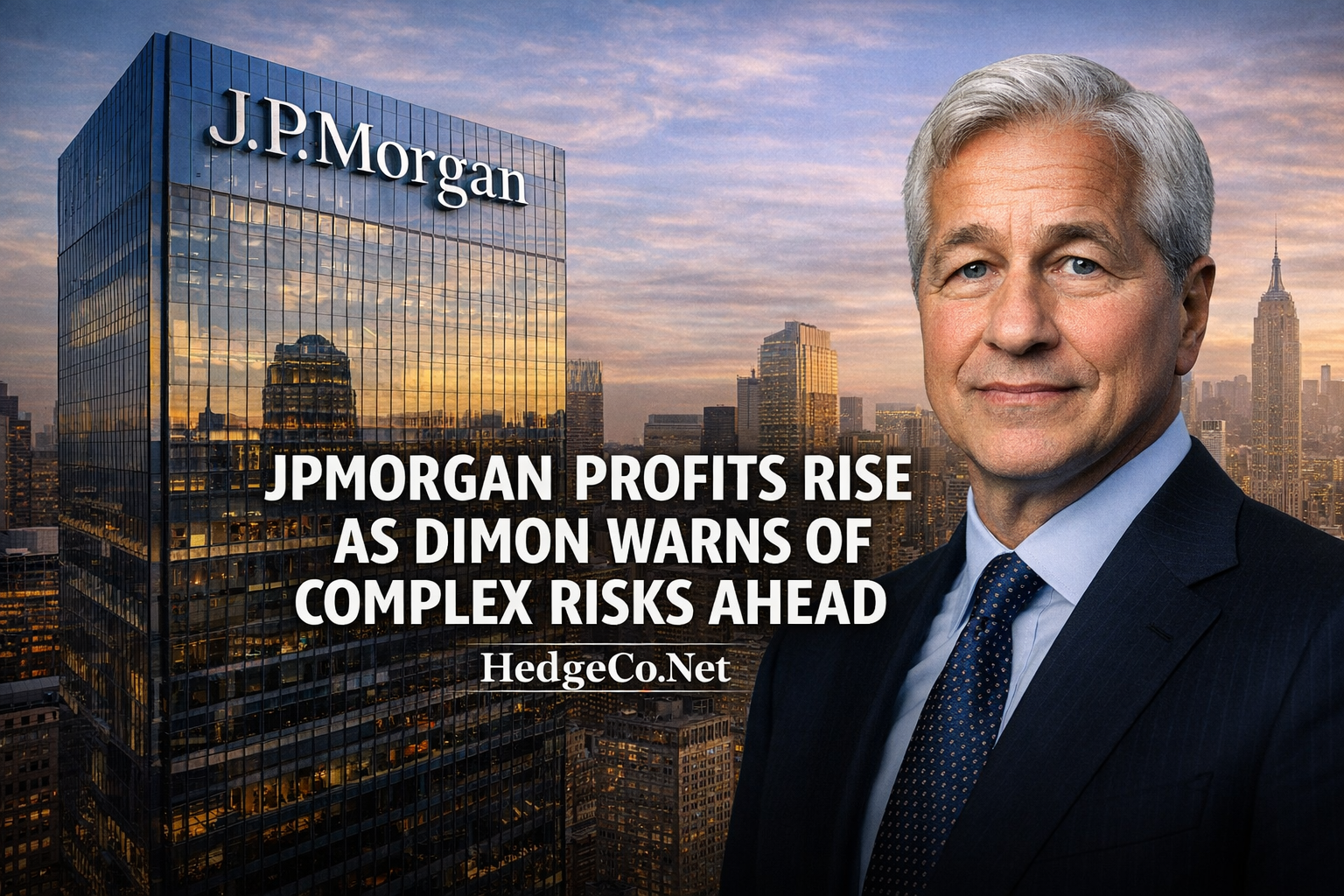
(HedgeCo.Net) — JPMorgan Chase delivered a strong start to 2026, reporting a 13% year-over-year increase in first-quarter profits, driven by resilient economic activity and a resurgence in Wall Street dealmaking. Yet even as the bank posted robust results, CEO Jamie Dimon struck a notably cautious tone, warning that an increasingly complex and uncertain macroeconomic landscape could challenge financial markets in the months ahead.
The juxtaposition of strong earnings and heightened caution encapsulates the current state of global finance: a system that continues to generate profits in the short term, even as structural risks accumulate beneath the surface.
A Strong Quarter: Earnings Driven by Fees and Resilience
JPMorgan’s first-quarter results exceeded expectations, with net income rising 13% compared to the same period last year. The performance was fueled by several key drivers, including a rebound in investment banking activity, strong trading revenues, and continued resilience in consumer and commercial banking segments.
Investment banking fees, which had been subdued during periods of market uncertainty in 2025, showed signs of recovery as dealmaking activity picked up. Mergers and acquisitions, equity underwriting, and debt issuance all contributed to improved revenue, reflecting a gradual normalization of capital markets.
Trading desks also delivered solid performance, benefiting from increased market volatility. Fixed income, currencies, and commodities (FICC) trading in particular saw elevated activity, as clients repositioned portfolios in response to shifting macro conditions.
On the consumer side, credit card spending remained robust, supported by a still-healthy labor market and resilient consumer confidence. Loan growth, while moderating, continued to provide a steady source of income for the bank.
Dimon’s Warning: A More Complex Risk Environment
Despite the strong headline numbers, Jamie Dimon emphasized that the operating environment is becoming increasingly complex. His comments highlighted a range of interconnected risks, including geopolitical tensions, inflationary pressures, and evolving monetary policy dynamics.
“We are navigating one of the most complicated global environments in decades,” Dimon said. “While the economy remains resilient today, there are significant uncertainties that could impact growth and financial stability.”
Among the most pressing concerns is the potential for geopolitical escalation, particularly in energy-sensitive regions. Rising tensions in the Middle East have already begun to influence oil prices, with implications for inflation and global economic activity.
Dimon also pointed to the ongoing impact of higher interest rates, which continue to shape both consumer behavior and corporate investment decisions. While higher rates have benefited banks through increased net interest income, they also pose risks to credit quality and economic growth.
Investment Banking Rebound: A Key Growth Engine
A standout feature of JPMorgan’s quarter was the rebound in investment banking activity. After a period of subdued deal flow, the first quarter of 2026 saw renewed momentum in capital markets.
Corporate confidence, while still tempered by macro uncertainty, appears to be stabilizing. Companies are increasingly willing to pursue strategic transactions, including mergers, acquisitions, and capital raises, particularly in sectors less exposed to geopolitical risk.
Equity markets have also played a role, with improved valuations enabling companies to access capital more efficiently. Debt markets, meanwhile, have remained active as firms seek to refinance existing obligations and lock in funding amid uncertain rate trajectories.
For JPMorgan, which consistently ranks among the top global investment banks, this resurgence has translated into higher fee income and improved profitability.
Trading Revenues: Volatility as an Opportunity
Market volatility, often viewed as a risk, has proven to be a source of opportunity for JPMorgan’s trading operations. Increased fluctuations in interest rates, currencies, and commodities have driven higher client activity, boosting trading revenues.
FICC trading has been particularly strong, reflecting heightened demand for hedging and risk management solutions. Clients, ranging from institutional investors to corporate treasurers, are actively adjusting positions to navigate the evolving macro landscape.
Equities trading has also contributed, though to a lesser extent, as investors respond to sector rotations and earnings developments.
The ability to capitalize on volatility is a core strength for large, diversified banks like JPMorgan, which possess the scale and infrastructure to manage complex trading operations.
Consumer Banking: Resilience Amid Rising Rates
JPMorgan’s consumer banking division continues to demonstrate resilience, supported by a strong labor market and steady wage growth. Credit card spending remains robust, indicating that consumers are still willing to spend despite higher borrowing costs.
However, there are early signs of moderation. Delinquency rates, while still within manageable levels, have begun to tick upward, particularly among lower-income borrowers. This trend is being closely monitored by the bank, as it could signal broader stress in the consumer sector.
Mortgage activity has also been impacted by higher interest rates, with refinancing volumes remaining subdued. Nevertheless, demand for new home purchases has shown some stability, supported by limited housing supply.
Net Interest Income: A Double-Edged Sword
Higher interest rates have been a key driver of bank profitability in recent quarters, boosting net interest income (NII) as lending rates increase faster than deposit costs. JPMorgan has been a major beneficiary of this dynamic.
However, Dimon cautioned that the benefits of higher rates may begin to diminish over time. As competition for deposits intensifies, banks may be forced to offer higher yields to retain customers, compressing margins.
Additionally, higher borrowing costs can dampen loan demand and increase the risk of defaults, particularly in more leveraged sectors of the economy.
“This is not a one-way benefit,” Dimon noted. “Higher rates help in the short term, but they also introduce longer-term risks.”
Credit Quality: Early Signs of Stress
One area of focus for investors is credit quality. While JPMorgan’s loan portfolio remains strong overall, there are emerging signs of stress in certain segments.
Commercial real estate, particularly office properties, continues to face challenges as remote and hybrid work models reduce demand. Valuations in this sector have come under pressure, raising concerns about potential losses.
Corporate credit is another area to watch, especially among highly leveraged firms. Rising interest rates increase debt servicing costs, which could strain balance sheets if economic growth slows.
JPMorgan has taken a proactive approach, increasing loan loss provisions to account for potential deterioration in credit conditions.
Geopolitical Risks: A Growing Concern

Geopolitical risk remains a central theme in Dimon’s outlook. Tensions in the Middle East, particularly around key energy routes, have the potential to disrupt global markets and economic activity.
Energy prices are a critical transmission mechanism for these risks. A sustained increase in oil prices would not only impact inflation but also reduce consumer purchasing power and corporate profitability.
Dimon emphasized that the interconnected nature of global markets means that localized conflicts can have far-reaching consequences.
“We cannot view these risks in isolation,” he said. “They are interconnected, and they have the potential to amplify each other.”
The Broader Banking Sector: Strength and Vulnerability
JPMorgan’s performance reflects broader trends within the banking sector. Large, diversified institutions have generally benefited from higher interest rates and increased market activity, while smaller banks face more significant challenges.
Regional banks, in particular, have been under pressure due to higher funding costs and concerns about asset quality. The divergence between large and small institutions is becoming more pronounced.
This dynamic has implications for financial stability, as stress in one part of the system can spill over into others.
Looking Ahead: Navigating Uncertainty
As JPMorgan looks ahead to the remainder of 2026, the key challenge will be navigating an environment characterized by both opportunity and risk. On the one hand, strong economic fundamentals and active capital markets provide a foundation for continued profitability. On the other, geopolitical tensions, inflationary pressures, and evolving monetary policy create significant uncertainty.
Dimon’s message to investors is one of cautious optimism: the bank is well-positioned to weather potential challenges, but vigilance is essential.
Conclusion: Strength Today, Uncertainty Tomorrow
JPMorgan’s first-quarter results highlight the resilience of the banking sector, even in the face of a complex and evolving macroeconomic landscape. Strong earnings, driven by investment banking, trading, and consumer activity, underscore the bank’s ability to adapt to changing conditions.
Yet Jamie Dimon’s warning serves as a reminder that the current environment is far from stable. The interplay of geopolitical risk, inflation, and monetary policy creates a level of uncertainty that cannot be ignored.
For investors, the key takeaway is clear: while the financial system remains robust, the risks are real—and they are growing more complex. As Dimon concluded, “We are in a strong position today, but we must be prepared for a wide range of outcomes. The world is changing, and we must change with it.”