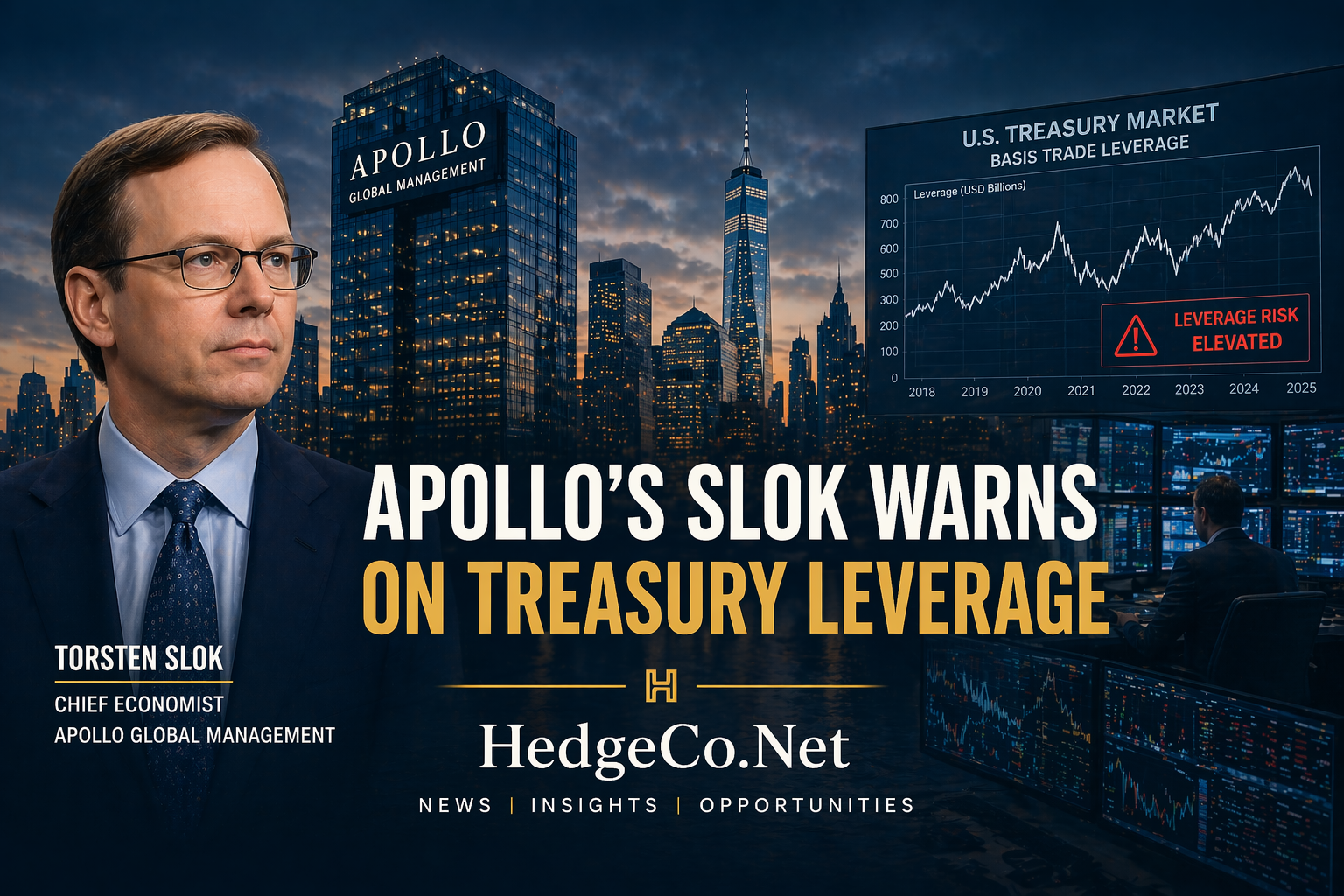
(HedgeCo.Net) A fresh warning from Torsten Slok, chief economist at Apollo Global Management, is sending ripples through institutional trading desks and risk committees across Wall Street. In a note circulated to clients today, Slok raised renewed concerns about the scale of hedge fund leverage embedded in the U.S. Treasury market—specifically pointing to the growing risks associated with the so-called “basis trade.”
At a moment when markets are already bracing for heightened volatility tied to earnings season—what traders have dubbed the “Super Bowl of Earnings”—Slok’s warning lands with particular force. His core message is clear: if a sudden deleveraging event is triggered, the unwinding of leveraged Treasury positions could amplify market stress in ways that extend far beyond fixed income.
Understanding the Basis Trade: A Quiet Corner of the Market With Systemic Implications
The Treasury basis trade is a relative-value strategy that exploits price differences between cash U.S. Treasuries and Treasury futures. In its simplest form, hedge funds buy Treasury bonds in the cash market while simultaneously selling Treasury futures, aiming to capture the spread between the two.
While the arbitrage opportunity itself may appear modest, the trade becomes meaningful when executed at scale—and with leverage. Hedge funds often finance the cash leg of the trade through the repurchase (repo) market, allowing them to amplify returns through borrowed capital.
In recent years, this strategy has grown significantly in size. Market participants estimate that hundreds of billions of dollars are now tied up in basis trades, making it one of the largest—and least visible—sources of leverage in the financial system.
Leverage in the Treasury Market: A Double-Edged Sword
Leverage is a fundamental feature of modern financial markets, enabling participants to deploy capital efficiently and enhance returns. However, it also introduces fragility—particularly when positions become crowded or dependent on stable funding conditions.
Slok’s concern centers on the scale and concentration of leverage in the Treasury market. Unlike equities, where leverage is often more transparent, the Treasury market’s reliance on repo financing creates a web of interconnected exposures that can be difficult to fully assess.
When markets are stable, this system functions smoothly. But when volatility rises—whether due to macroeconomic shocks, policy shifts, or liquidity disruptions—the same leverage that enhances returns can quickly become a source of instability.
Echoes of March 2020: A Market Memory That Still Lingers
For many market veterans, Slok’s warning evokes memories of March 2020, when the Treasury market experienced a sudden and severe dislocation at the onset of the COVID-19 pandemic.
During that period, hedge funds engaged in basis trades were forced to unwind positions rapidly as volatility spiked and funding conditions tightened. The resulting selling pressure overwhelmed market liquidity, leading to sharp price swings in what is typically considered the world’s safest and most liquid asset class.
The Federal Reserve ultimately intervened with massive asset purchases and liquidity injections to stabilize the market. While those measures were effective, they also highlighted the vulnerability of the Treasury market to leveraged trading strategies.
Why the Risk Is Re-Emerging Now
Several factors are contributing to the renewed buildup of basis trade exposure:
1. Elevated Yield Levels
Higher interest rates have increased the attractiveness of Treasury securities, creating more opportunities for relative-value trades. The wider spreads between cash bonds and futures contracts have made the basis trade more profitable—encouraging greater participation.
2. Abundant Liquidity in Repo Markets
The availability of financing through the repo market has remained robust, allowing hedge funds to maintain and expand leveraged positions. Low haircuts and competitive funding rates have further incentivized leverage.
3. Increased Hedge Fund Participation
Multi-strategy hedge funds and relative-value specialists have increasingly allocated capital to basis trades as part of their fixed-income strategies. The scale of participation has grown alongside the broader expansion of the hedge fund industry.
The “Super Bowl of Earnings” as a Potential Catalyst
Slok’s reference to the “Super Bowl of Earnings” is particularly noteworthy. Earnings season often serves as a focal point for market volatility, as companies report results that can shift investor expectations and trigger rapid repricing across asset classes.
If earnings disappoint or macroeconomic data surprises to the downside, risk assets could sell off—potentially leading to a broader tightening of financial conditions. In such an environment, hedge funds may be forced to reduce leverage, including unwinding basis trades.
This is where the risk becomes systemic. A rapid unwinding of leveraged positions could create a feedback loop: selling pressure drives price dislocations, which in turn triggers further deleveraging.
Liquidity Versus Depth: The Hidden Fragility of Treasuries
The U.S. Treasury market is often described as the deepest and most liquid market in the world. However, recent episodes have revealed that liquidity can be more fragile than it appears—particularly during periods of stress.
Market depth—the ability to absorb large trades without significant price impact—has declined in recent years due to a combination of regulatory changes, reduced dealer balance sheets, and increased reliance on electronic trading.
This means that even modest shifts in supply and demand can lead to outsized price movements, especially when amplified by leveraged positions.
Institutional Implications: Risk Management Comes Into Focus
Slok’s warning is prompting institutional investors to revisit their risk management frameworks, particularly with respect to fixed-income exposures.
Key areas of focus include:
- Counterparty Risk: Assessing exposure to hedge funds and other leveraged participants.
- Liquidity Planning: Ensuring that portfolios can withstand periods of reduced market liquidity.
- Stress Testing: Modeling scenarios involving rapid deleveraging and market dislocation.
For asset managers, the challenge is to balance the pursuit of returns with the need to manage systemic risks.
The Role of Central Banks: Backstop or Moral Hazard?
One of the critical questions raised by the current environment is the role of central banks in stabilizing markets.
The Federal Reserve’s intervention in 2020 demonstrated its willingness to act as a backstop in times of crisis. However, this raises concerns about moral hazard—namely, that market participants may take on excessive risk in the expectation of future support.
Slok’s warning implicitly underscores this tension. While central bank intervention can mitigate immediate risks, it may also contribute to the buildup of leverage over time.
A Broader Shift in Market Structure
The rise of basis trades and other leveraged strategies reflects a broader shift in market structure. Traditional dealers have reduced their role as intermediaries, while hedge funds and other non-bank participants have become more prominent.
This evolution has increased efficiency in some respects, but it has also introduced new vulnerabilities. Unlike banks, hedge funds are not subject to the same regulatory oversight, and their activities can be less transparent.
As a result, risks can accumulate in ways that are not immediately visible to regulators or market participants.
What Happens If the Trade Unwinds?
The potential consequences of a large-scale unwinding of basis trades extend beyond the Treasury market itself.
1. Treasury Market Volatility
A surge in selling pressure could lead to sharp price movements and increased volatility in Treasury yields.
2. Spillover Effects Across Asset Classes
Treasuries serve as a benchmark for pricing across global markets. Disruptions in the Treasury market could ripple through equities, credit, and foreign exchange.
3. Funding Market Stress
A sudden deleveraging could strain repo markets, leading to tighter funding conditions and higher borrowing costs.
4. Broader Financial Instability
In extreme scenarios, the combined effects of these dynamics could pose risks to overall financial stability.
Market Reaction: Watchful but Not Alarmed—Yet
Despite the seriousness of Slok’s warning, markets have so far remained relatively calm. Treasury yields have been volatile but orderly, and there is no immediate sign of a disorderly unwind.
However, traders and risk managers are paying close attention. The memory of past disruptions remains fresh, and the potential for rapid shifts in market conditions cannot be ignored.
Conclusion: A Risk Worth Watching Closely
The warning from Torsten Slok and Apollo Global Management serves as a timely reminder of the hidden complexities within the financial system. While the Treasury market remains a cornerstone of global finance, it is not immune to the effects of leverage and structural change.
As the “Super Bowl of Earnings” unfolds and macroeconomic uncertainties persist, the behavior of leveraged strategies like the basis trade will be a key factor in determining market stability.
For now, the risk remains contained—but as history has shown, conditions can change quickly. In an environment defined by leverage and interconnectedness, vigilance is not optional—it is essential.