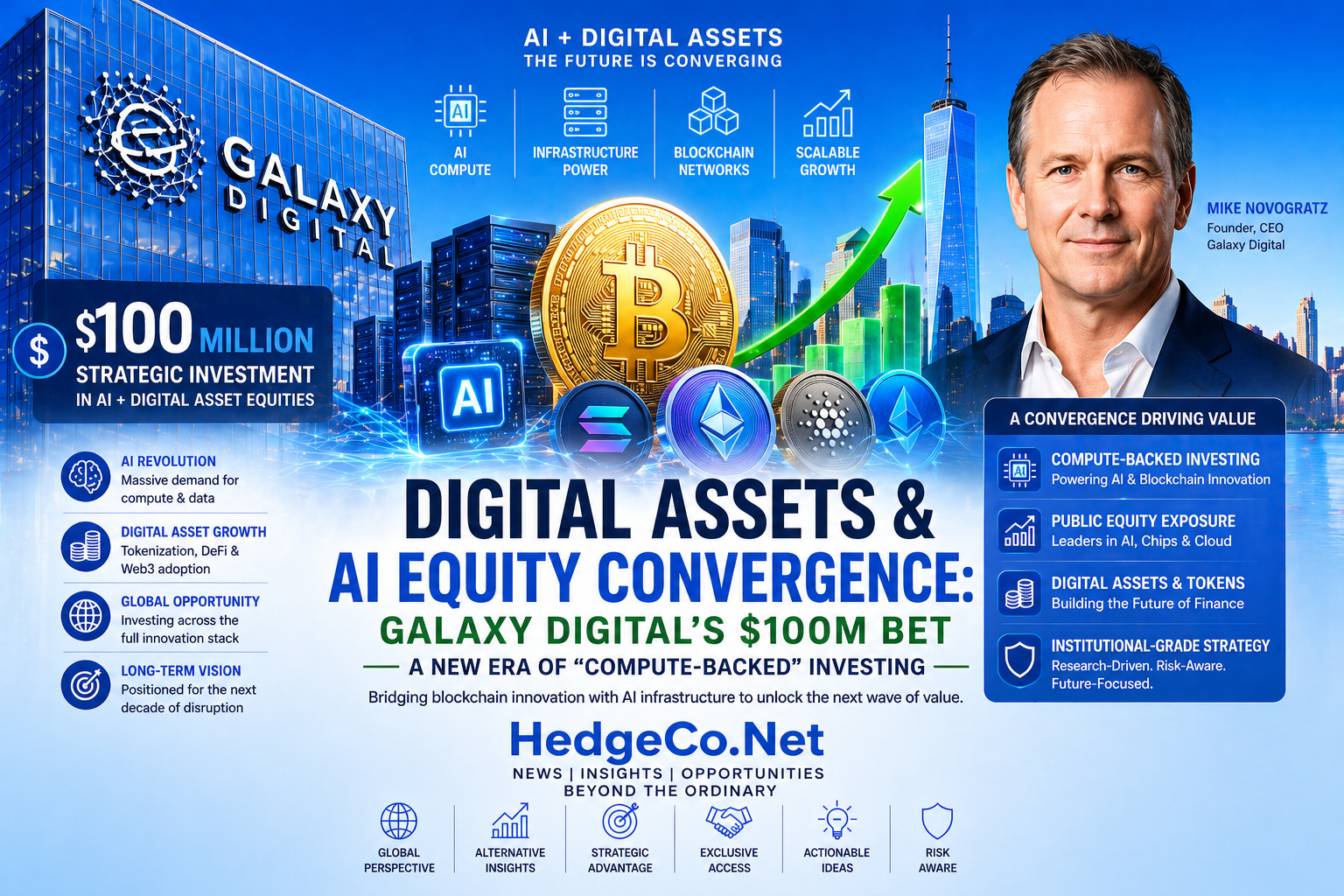
(HedgeCo.Net) The lines separating digital assets, artificial intelligence, and traditional equity markets are beginning to blur—and Galaxy Digital is moving aggressively to capitalize on the convergence. The firm’s newly announced $100 million push into a hybrid strategy combining digital assets with AI-driven equities represents more than just a tactical allocation shift; it signals a broader evolution in how capital is being deployed across the next generation of technology-driven markets.
For years, crypto-native funds operated largely within their own ecosystem, focusing on tokens, protocols, and decentralized finance (DeFi) applications. Meanwhile, AI investing remained firmly rooted in public equities, venture capital, and infrastructure plays. Now, those silos are dissolving, giving rise to a new class of strategies centered around what industry insiders are beginning to call “compute-backed” assets—investments tied directly to the infrastructure, data, and processing power underpinning both AI and blockchain networks.
Galaxy Digital’s move may well mark the inflection point.
From Tokens to Infrastructure: A Strategic Pivot
The crypto industry has undergone a profound transformation over the past several years. What began as a speculative market driven by token price volatility has matured into a more complex ecosystem encompassing infrastructure, enterprise adoption, and institutional capital flows.
In this new environment, pure-play token strategies are no longer sufficient to capture the full opportunity set. Instead, investors are increasingly focusing on the underlying infrastructure—data centers, GPUs, cloud platforms, and networking systems—that enable both AI and blockchain applications.
Galaxy Digital’s $100 million allocation reflects this shift. By combining exposure to digital assets with investments in AI-driven equities, the firm is effectively repositioning itself at the intersection of two of the most powerful technological trends of the decade.
This approach recognizes a fundamental reality: the value creation in both AI and crypto is increasingly tied to compute power.
The Rise of “Compute-Backed” Assets
At the heart of this convergence is the concept of compute. Artificial intelligence models—particularly large language models and generative AI systems—require immense amounts of computational power to train and operate. Similarly, blockchain networks depend on distributed computing resources to validate transactions and maintain network security.
This shared reliance on compute infrastructure creates a natural point of intersection between the two sectors. Companies that provide the hardware, software, and services necessary to support these workloads are becoming central to both ecosystems.
Public equities such as semiconductor manufacturers, cloud providers, and data infrastructure firms are already benefiting from this trend. At the same time, certain digital assets are evolving to incorporate elements of compute-based value, such as decentralized computing networks and tokenized infrastructure.
By integrating these exposures into a single strategy, Galaxy Digital is effectively betting that the future of investing lies not in isolated asset classes, but in the convergence of technology stacks.
Why Now? Timing the Convergence
The timing of Galaxy’s move is particularly significant. Several factors are converging to create a favorable environment for this hybrid strategy:
- AI Capital Expenditure Boom: Technology giants are investing hundreds of billions of dollars in AI infrastructure, driving demand for compute resources
- Crypto Market Maturation: Institutional adoption is increasing, with a growing focus on utility and infrastructure rather than speculation
- Data as a Strategic Asset: The value of data—both in training AI models and enabling blockchain applications—is becoming increasingly recognized
- Regulatory Clarity: Gradual progress in regulatory frameworks is making digital assets more accessible to institutional investors
Together, these trends are creating a new investment paradigm in which the boundaries between asset classes are increasingly fluid.
Institutional Capital Follows the Infrastructure
One of the most important developments in recent years has been the shift in institutional capital toward infrastructure-based investments. Large asset managers, sovereign wealth funds, and pension funds are increasingly allocating capital to data centers, cloud computing, and other digital infrastructure assets.
This trend is being driven by several factors, including the search for stable, long-duration cash flows and the recognition that digital infrastructure is becoming as essential as traditional infrastructure.
Galaxy Digital’s strategy aligns closely with this institutional perspective. By focusing on compute-backed assets, the firm is positioning itself to attract capital from investors seeking exposure to the foundational elements of the digital economy.
Bridging Public and Private Markets
Another key aspect of the hybrid strategy is its ability to bridge public and private markets. AI-driven equities provide liquid exposure to the growth of the sector, while digital assets offer access to emerging technologies and decentralized networks.
This combination allows for a more diversified approach to investing in technological innovation. It also enables investors to capture value across different stages of the investment lifecycle, from early-stage development to mature, publicly traded companies.
For Galaxy Digital, this multi-asset approach represents a significant evolution from its earlier focus on crypto markets. It reflects a broader industry trend toward integrated investment strategies that span multiple asset classes.
Competitive Landscape: A Race to Define the Future
Galaxy Digital is not alone in exploring the convergence of AI and digital assets. A growing number of firms are beginning to recognize the potential of this intersection, leading to increased competition.
Traditional asset managers such as BlackRock and Fidelity Investments have already made significant investments in both AI and digital assets, albeit through separate channels. Meanwhile, venture capital firms are actively funding startups that operate at the intersection of these technologies.
Crypto-native firms are also evolving, expanding beyond token trading to include infrastructure, venture investments, and asset management.
In this competitive environment, differentiation will be key. Galaxy Digital’s integrated approach may provide a first-mover advantage, but sustaining that advantage will require continuous innovation and execution.
Risks and Challenges
While the convergence of digital assets and AI presents significant opportunities, it also introduces a range of risks and challenges.
Volatility and Correlation
Digital assets remain highly volatile, and their correlation with traditional markets can vary significantly over time. Integrating them into a broader strategy requires careful risk management and portfolio construction.
Technological Uncertainty
Both AI and blockchain are rapidly evolving fields, with significant uncertainty surrounding future developments. Investments in these areas carry inherent risks related to technological disruption and obsolescence.
Regulatory Environment
Regulation remains a key consideration, particularly for digital assets. Changes in regulatory frameworks could impact market dynamics and investor access.
Execution Complexity
Managing a hybrid strategy that spans multiple asset classes requires specialized expertise and infrastructure. Ensuring effective execution will be critical to achieving desired outcomes.
A New Investment Framework
Despite these challenges, the convergence of digital assets and AI is likely to reshape the investment landscape. Traditional asset allocation frameworks, which rely on clear distinctions between asset classes, may become increasingly outdated.
Instead, a new framework is emerging—one that emphasizes themes, technologies, and value chains rather than asset categories. In this model, investments are evaluated based on their role within a broader ecosystem, rather than their classification as equities, bonds, or alternatives.
Galaxy Digital’s strategy reflects this shift. By focusing on compute-backed assets, the firm is aligning its investment approach with the underlying drivers of value creation in the digital economy.
Implications for Investors
For investors, the convergence of AI and digital assets presents both opportunities and challenges. On one hand, it offers access to high-growth sectors with significant long-term potential. On the other hand, it requires a more nuanced understanding of complex technologies and market dynamics.
Key considerations for investors include:
- Diversification: Balancing exposure across different segments of the ecosystem
- Risk Management: Understanding and mitigating volatility and correlation risks
- Time Horizon: Recognizing that many of these investments require a long-term perspective
- Expertise: Leveraging specialized knowledge and research capabilities
Looking Ahead: The Next Phase of Innovation
As the digital economy continues to evolve, the convergence of AI and digital assets is likely to accelerate. New technologies, business models, and investment opportunities will emerge, creating a dynamic and rapidly changing landscape.
For firms like Galaxy Digital, the challenge will be to stay ahead of these developments, continuously adapting their strategies to capture new sources of value.
At the same time, the broader industry will need to evolve, developing new tools, frameworks, and standards to support this next phase of innovation.
Conclusion
Galaxy Digital’s $100 million push into a hybrid AI and digital asset strategy represents a significant milestone in the evolution of alternative investing. By embracing the convergence of these two powerful trends, the firm is positioning itself at the forefront of a new investment paradigm.
The rise of compute-backed assets underscores the changing nature of value creation in the digital economy, highlighting the importance of infrastructure, data, and technology.
As investors seek to navigate this complex landscape, strategies that integrate multiple asset classes and leverage technological insights are likely to play an increasingly important role.
In this new era, the boundaries between markets are dissolving—and those who can successfully navigate the convergence will be best positioned to capture the opportunities ahead.