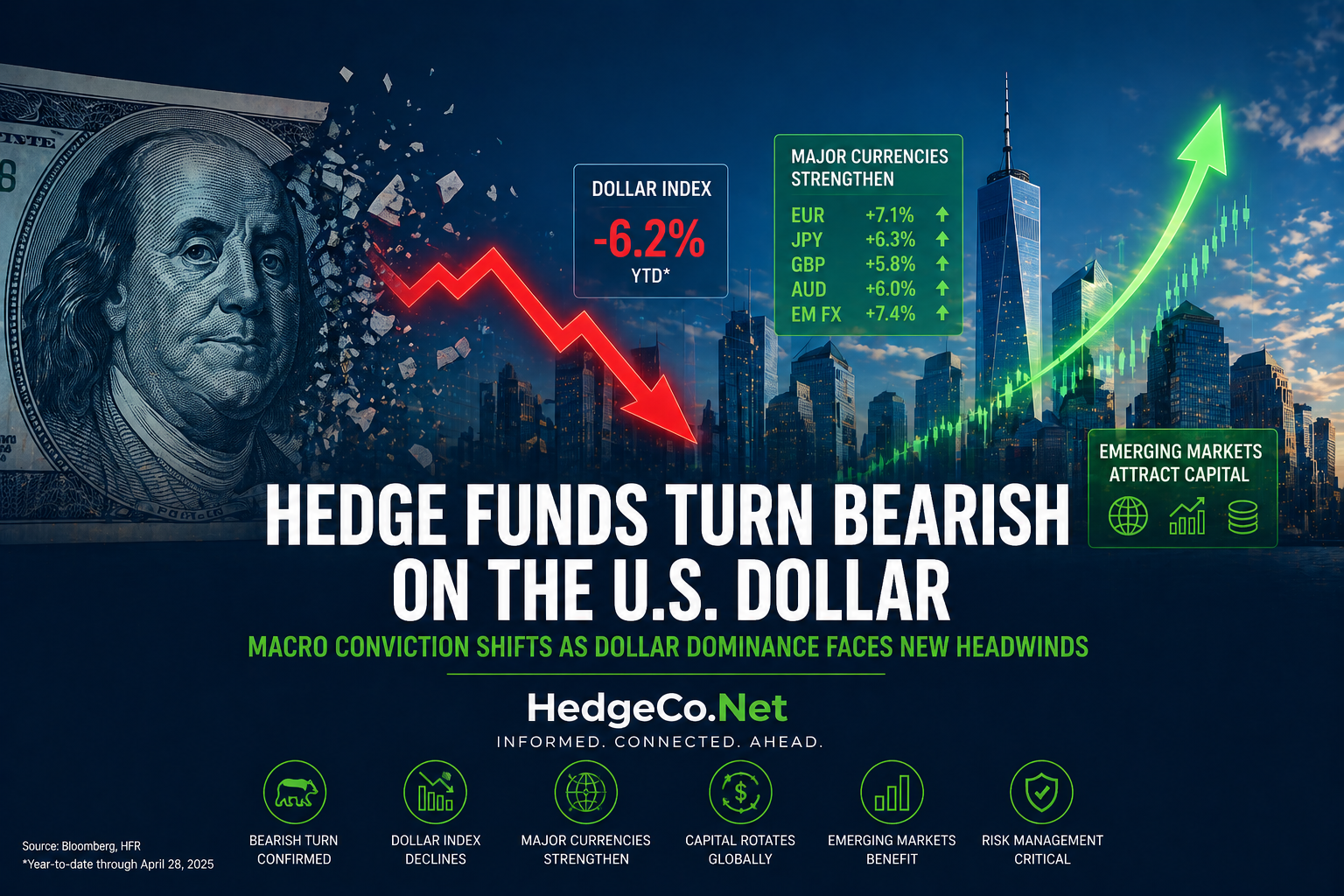
(HedgeCo.Net) A notable shift is emerging across global macro trading desks: hedge funds are increasingly positioning for a weaker U.S. dollar. After years of strength driven by interest rate differentials, safe-haven demand, and global uncertainty, the greenback is now facing a growing wave of bearish sentiment from some of the industry’s most sophisticated investors.
From large multi-strategy platforms to dedicated macro funds, positioning data and market flows suggest a coordinated recalibration of views. The implications are far-reaching, touching everything from global capital allocation and commodity pricing to emerging markets and cross-asset volatility. For institutional investors, the question is no longer whether the dollar has peaked—but what comes next.
The Dollar’s Long Run of Dominance
The U.S. dollar has enjoyed a prolonged period of strength, supported by a combination of structural and cyclical factors. As the world’s primary reserve currency, it benefits from deep liquidity, robust financial markets, and the enduring confidence of global investors.
In recent years, additional tailwinds have reinforced this dominance. The Federal Reserve’s aggressive tightening cycle widened interest rate differentials in favor of the U.S., attracting capital inflows. At the same time, geopolitical tensions—from Eastern Europe to the Middle East—boosted demand for dollar-denominated assets as a safe haven.
These dynamics pushed the dollar to multi-year highs, creating challenges for global markets. Emerging economies faced currency depreciation pressures, multinational corporations grappled with translation effects, and commodity prices—often priced in dollars—became more volatile.
The Inflection Point
The current shift in hedge fund positioning suggests that the dollar’s dominance may be entering a new phase. While not necessarily signaling an imminent collapse, the growing bearish consensus reflects a belief that the factors supporting dollar strength are beginning to fade. Several key developments underpin this view:
Easing Interest Rate Differentials
As the Federal Reserve approaches the end of its tightening cycle, the gap between U.S. interest rates and those of other major economies is narrowing. Central banks in Europe and parts of Asia are either maintaining elevated rates or adopting more hawkish stances, reducing the relative attractiveness of dollar assets.
Stabilizing Global Growth
Improving economic conditions outside the United States are encouraging investors to diversify their exposures. As growth prospects in regions such as Europe and emerging markets strengthen, capital flows are beginning to shift.
Geopolitical De-escalation
While risks remain, the perception of reduced geopolitical tension is diminishing the need for safe-haven assets. This shift in sentiment is contributing to a decline in defensive positioning.
Hedge Funds Lead the Charge
Hedge funds are often at the forefront of macro positioning, leveraging their flexibility and access to information to anticipate market shifts. The current bearish stance on the dollar reflects a convergence of views across different strategies.
Macro-focused firms, in particular, are actively expressing this theme through a range of trades, including short dollar positions against major currencies, long positions in commodities, and increased exposure to emerging market assets.
Multi-strategy platforms such as Millennium Management and Citadel are also participating, integrating dollar bearishness into broader portfolios that span equities, fixed income, and derivatives. This widespread adoption amplifies the impact of the trade, creating a feedback loop that can accelerate market movements.
Currency Markets React
The shift in positioning is already influencing currency markets. The dollar has shown signs of softening against a basket of major currencies, with notable strength emerging in the euro, yen, and select emerging market currencies.
Volatility in foreign exchange markets has also increased, reflecting the uncertainty surrounding the dollar’s trajectory. For traders, this environment presents both opportunities and risks, requiring careful navigation and disciplined risk management.
Implications for Global Asset Allocation
A weaker dollar has significant implications for global asset allocation. Historically, periods of dollar weakness have been associated with improved performance in international equities, commodities, and emerging markets.
Emerging Markets
A declining dollar reduces the burden of dollar-denominated debt for emerging economies, improving financial conditions and supporting growth. This dynamic can lead to increased capital inflows and stronger equity market performance.
Commodities
Commodities, which are typically priced in dollars, tend to benefit from a weaker currency. As the dollar declines, commodity prices often rise, providing a tailwind for sectors such as energy, metals, and agriculture.
Global Equities
Non-U.S. equities may outperform as currency translation effects become more favorable and capital flows diversify away from U.S. markets.
The Role of Central Banks
Central banks play a critical role in shaping currency dynamics. The Federal Reserve’s policy decisions will be a key determinant of the dollar’s path, particularly as markets assess the timing and magnitude of potential rate cuts.
At the same time, actions by other central banks—such as the European Central Bank and the Bank of Japan—will influence relative currency movements. Divergence in monetary policy can create opportunities for hedge funds to exploit interest rate differentials and currency mispricings.
Risks to the Bearish Thesis
While the bearish case for the dollar is gaining traction, it is not without risks. Several factors could challenge this narrative:
Renewed Geopolitical Tensions
A resurgence of geopolitical instability could reignite safe-haven demand, driving investors back into the dollar.
Economic Resilience in the U.S.
If the U.S. economy continues to outperform its peers, the dollar may retain its appeal, particularly if growth differentials remain significant.
Policy Surprises
Unexpected shifts in central bank policy—such as a more hawkish stance from the Federal Reserve—could alter market expectations and reverse current trends.
The Broader Macro Narrative
The shift in hedge fund positioning reflects a broader evolution in the macro landscape. After years of dollar dominance, the global economy is entering a more balanced phase, characterized by diversified growth and shifting capital flows.
For investors, this transition presents both challenges and opportunities. Navigating the changing environment requires a nuanced understanding of macro dynamics, as well as the ability to adapt strategies in response to evolving conditions.
Strategic Positioning for Investors
In light of the changing outlook for the dollar, investors are reassessing their portfolios and considering potential adjustments:
- Currency Hedging: Managing exposure to currency fluctuations becomes increasingly important in a volatile environment.
- Diversification: Expanding allocations to international assets can help capture opportunities associated with a weaker dollar.
- Commodity Exposure: Incorporating commodities into portfolios may provide a hedge against currency depreciation.
- Active Management: Leveraging active strategies can enhance the ability to navigate complex market dynamics.
A Turning Point or a Tactical Trade?
One of the key questions facing investors is whether the current bearish stance represents a long-term structural shift or a shorter-term tactical trade.
On one hand, the factors driving the shift—such as narrowing rate differentials and improving global growth—suggest a potential change in the dollar’s trajectory. On the other hand, currency markets are inherently cyclical, and periods of weakness are often followed by rebounds.
For hedge funds, the answer may lie in flexibility. By maintaining the ability to adjust positions quickly, they can capitalize on opportunities while managing risks.
Conclusion: A New Phase for the Dollar
The growing bearish sentiment among hedge funds marks a significant development in the global macro landscape. While the U.S. dollar remains a cornerstone of the financial system, its trajectory is increasingly subject to changing dynamics.
For HedgeCo.Net readers, the implications are clear: the era of unchallenged dollar strength may be giving way to a more complex and nuanced environment. As hedge funds position for this shift, their actions will not only reflect market trends but also help shape them. Whether this marks the beginning of a sustained decline or a temporary adjustment, one thing is certain—the dollar is once again at the center of the global investment conversation.