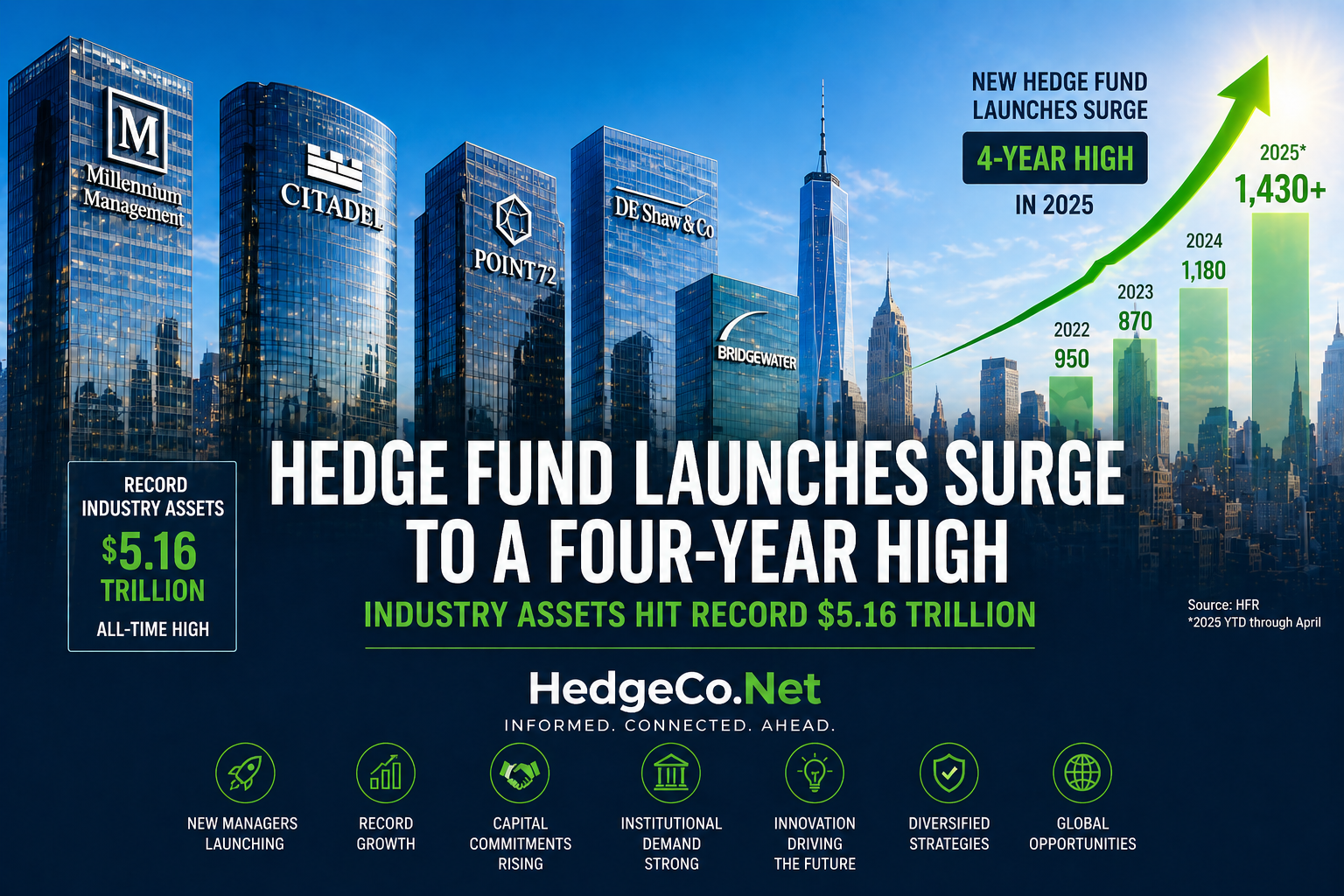
(HedgeCo.Net) The hedge fund industry is showing renewed signs of vitality. According to newly released data from HFR, hedge fund launches have climbed to their highest level since 2021, while total industry assets have reached a record $5.16 trillion. The dual milestone underscores a powerful combination of entrepreneurial resurgence and institutional demand, signaling that the sector may be entering a new phase of expansion after several years of consolidation.
For allocators, the surge in launches reflects a growing appetite for differentiated, liquid strategies in an increasingly complex macro environment. For managers, it represents both an opportunity and a challenge—an opportunity to capitalize on favorable fundraising conditions, and a challenge to stand out in an increasingly competitive landscape.
A Reawakening After Consolidation
The hedge fund industry has undergone a period of consolidation in recent years. Rising costs, regulatory pressures, and heightened competition have forced many smaller funds to shut down or merge, leading to a concentration of assets among larger, established platforms.
However, the latest data suggests that this consolidation phase may be giving way to a new wave of formation. The increase in launches indicates that market conditions are once again conducive to new entrants, driven by improved performance, investor demand, and the availability of capital.
This reawakening is particularly notable given the backdrop of macroeconomic uncertainty. Rather than deterring new managers, volatility appears to be creating opportunities for those with specialized expertise and innovative strategies.
Record Assets Reflect Institutional Commitment
The rise in hedge fund launches is occurring alongside a record level of industry assets—$5.16 trillion. This figure highlights the enduring appeal of hedge funds as a core component of institutional portfolios.
Investors are increasingly seeking strategies that offer diversification, downside protection, and the potential for uncorrelated returns. In a world where traditional asset classes face structural challenges, hedge funds provide a flexible and adaptive approach to navigating market complexities.
The growth in assets also reflects the continued institutionalization of the industry. Large allocators, including pension funds, endowments, and sovereign wealth funds, are playing a central role in shaping capital flows, often favoring managers with robust infrastructure and proven track records.
Drivers of the Launch Boom
Several factors are contributing to the resurgence in hedge fund launches:
Market Volatility
Periods of volatility create opportunities for active managers to generate alpha. As dispersion increases across asset classes, skilled managers can exploit inefficiencies and capitalize on mispricings.
Talent Migration
The competitive dynamics of large multi-manager platforms—such as Millennium Management and Citadel—are driving talent mobility. Portfolio managers who leave these platforms often launch their own funds, bringing with them experience, relationships, and, in some cases, seed capital.
Investor Demand for Differentiation
Allocators are increasingly looking for niche strategies that complement their existing exposures. This demand is creating space for specialized funds focused on areas such as credit arbitrage, event-driven strategies, and emerging markets.
Improved Infrastructure
Advancements in technology and the availability of outsourced services have lowered the barriers to entry for new managers. From prime brokerage to compliance and risk management, a wide range of support functions can now be accessed on a modular basis.
The Rise of the “Emerging Manager” Narrative
The surge in launches has reignited interest in emerging managers—firms that are typically in their early stages of development and offer the potential for high growth.
For investors, emerging managers present a compelling proposition. They often bring fresh perspectives, greater agility, and a strong alignment of interests. Additionally, early-stage funds may offer more favorable fee structures and capacity for significant performance-driven returns.
However, investing in emerging managers also carries risks, including limited track records and operational challenges. As a result, allocators are adopting more sophisticated approaches to due diligence, leveraging both internal resources and external consultants to identify high-quality opportunities.
The Role of Seeding and Strategic Partnerships
Seeding arrangements and strategic partnerships are playing a crucial role in facilitating new fund launches. Established firms and specialized seeders provide capital in exchange for revenue shares or equity stakes, enabling new managers to build their businesses.
These partnerships offer benefits for both parties. For emerging managers, they provide access to capital, infrastructure, and distribution networks. For seeders, they offer exposure to potential high-performing strategies at an early stage.
The increasing prevalence of these arrangements reflects a more collaborative ecosystem within the hedge fund industry, where capital and expertise are leveraged to drive growth.
Competition Intensifies
While the rise in launches is a positive sign for the industry, it also intensifies competition. New entrants must differentiate themselves in a crowded marketplace, competing not only with each other but also with established giants.
Large platforms continue to dominate asset flows, benefiting from their scale, resources, and track records. For smaller funds, carving out a niche is essential to attracting investor attention.
This competitive environment is driving innovation, with managers exploring new strategies, leveraging advanced analytics, and incorporating alternative data sources to gain an edge.
Strategy Trends Among New Launches
The latest wave of hedge fund launches reveals several emerging trends in strategy focus:
Multi-Strategy and Hybrid Models
Some new funds are adopting multi-strategy approaches, combining elements of traditional hedge fund strategies to create diversified portfolios.
Credit and Structured Products
With interest rates elevated, credit strategies are gaining traction, offering attractive risk-adjusted returns.
Quantitative and Data-Driven Approaches
The integration of technology and data analytics is enabling new funds to develop sophisticated quantitative strategies.
ESG and Impact Investing
Environmental, social, and governance (ESG) considerations are becoming increasingly important, with some funds incorporating these factors into their investment processes.
Challenges Facing New Managers
Despite favorable conditions, launching a hedge fund remains a complex and challenging endeavor. New managers must navigate a range of hurdles, including:
- Raising Capital: Securing initial commitments can be difficult, particularly in a competitive environment.
- Building Infrastructure: Establishing operational capabilities is essential for meeting investor expectations.
- Regulatory Compliance: Navigating regulatory requirements requires expertise and resources.
- Performance Pressure: Delivering strong returns is critical to attracting and retaining investors.
These challenges underscore the importance of preparation, planning, and execution in the launch process.
The Impact on the Broader Industry
The resurgence in hedge fund launches has broader implications for the industry:
Increased Innovation
New entrants bring fresh ideas and approaches, driving innovation across the sector.
Greater Diversity of Strategies
A wider range of strategies enhances the overall ecosystem, providing investors with more options.
Pressure on Fees
Competition may lead to more competitive fee structures, benefiting investors.
Evolution of the Talent Market
The movement of talent between firms is reshaping the industry, creating new opportunities and challenges.
Institutional Allocators Reassess Portfolios
The growth in hedge fund launches is prompting institutional investors to reassess their portfolios. While large platforms remain core holdings, there is increasing interest in allocating to emerging managers as a source of alpha.
This balanced approach allows investors to benefit from the stability of established firms while capturing the potential upside of new entrants.
However, the allocation process requires careful consideration, including diversification, risk management, and alignment with long-term objectives.
A New Growth Cycle for Hedge Funds?
The combination of rising launches and record assets suggests that the hedge fund industry may be entering a new growth cycle. After a period of consolidation, the sector appears poised for expansion, driven by both supply and demand dynamics.
For managers, this represents an opportunity to innovate and grow. For investors, it offers access to a broader range of strategies and potential sources of return.
However, sustaining this growth will depend on the industry’s ability to deliver consistent performance and adapt to changing market conditions.
Conclusion: Momentum Builds, but Execution Will Define Success
The surge in hedge fund launches to a four-year high, coupled with record industry assets of $5.16 trillion, marks a significant moment for the alternative investment landscape.
For HedgeCo.Net readers, the key takeaway is clear: the hedge fund industry is not only alive—it is evolving. New managers are entering the market, bringing innovation and competition, while institutional capital continues to flow into the sector.
Yet, as momentum builds, execution will be the defining factor. In a competitive and dynamic environment, only those managers who can deliver consistent performance, manage risk effectively, and differentiate their strategies will succeed.
The next chapter of the hedge fund industry is being written—and it is one defined by opportunity, innovation, and the relentless pursuit of alpha.