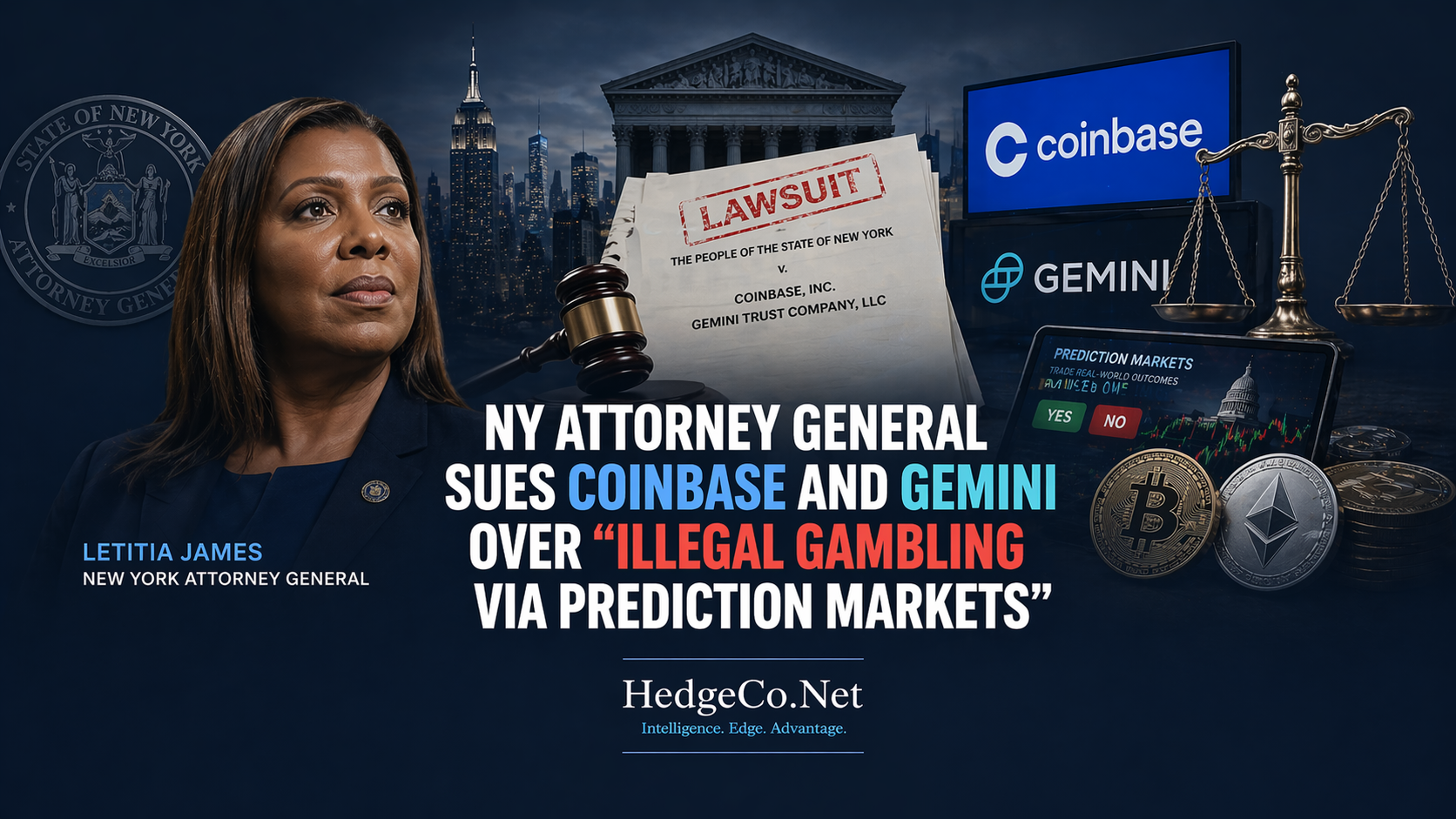
(HedgeCo.Net) In a significant escalation of regulatory pressure on the digital asset industry, Letitia James has filed a sweeping lawsuit against Coinbase and Gemini, alleging that both platforms operated unlicensed “illegal gambling” enterprises through the offering of event-based prediction markets.
The lawsuit marks one of the most aggressive state-level actions to date targeting the rapidly expanding “event contracts” sector—a niche within crypto that has exploded in popularity amid the 2026 U.S. election cycle. By framing prediction markets as gambling rather than financial instruments, the case introduces a new legal front in the ongoing battle over how digital asset innovation should be classified, regulated, and ultimately governed.
For the broader alternative investment ecosystem, the implications are far-reaching. The case not only challenges the business models of two of the industry’s most prominent exchanges but also raises fundamental questions about the boundaries between speculation, hedging, and gaming in modern financial markets.
The Core Allegation: Financial Innovation or Digital Gambling?
At the heart of the lawsuit is a deceptively simple question: Are event-based prediction markets legitimate financial instruments—or are they, in essence, unregulated betting platforms?
According to the complaint filed by the New York Attorney General’s office, the products offered by Coinbase and Gemini allowed users to place trades on the outcomes of real-world events—ranging from political elections to economic indicators and global developments. These contracts, often structured as binary outcomes (“yes” or “no”), enable participants to profit based on whether a specific event occurs.
While proponents argue that such markets serve valuable purposes—such as price discovery, risk hedging, and information aggregation—the lawsuit contends that, in practice, they function as wagering mechanisms indistinguishable from gambling.
The legal distinction is critical.
If classified as financial instruments, these products fall under the jurisdiction of regulatory bodies such as the CFTC. If deemed gambling, however, they may be subject to state-level gaming laws—many of which impose strict licensing requirements or outright prohibitions.
By asserting that these contracts were offered without appropriate licenses, the lawsuit effectively challenges the legal foundation of the entire event-contract ecosystem.
Why Now? The 2026 Election Catalyst
The timing of the lawsuit is no coincidence.
The 2026 U.S. election cycle has driven unprecedented interest in prediction markets, with traders seeking to monetize insights into political outcomes. Event-based contracts tied to election results, policy decisions, and geopolitical developments have seen explosive growth, drawing in both retail participants and sophisticated investors.
This surge has amplified regulatory concerns on multiple fronts:
- Market Integrity: Ensuring that prices reflect genuine information rather than manipulation
- Consumer Protection: Safeguarding retail investors from risks they may not fully understand
- Political Sensitivity: Addressing the optics of financializing democratic processes
For regulators, the rapid expansion of these markets—combined with their accessibility through crypto platforms—has created a sense of urgency.
Letitia James’ office appears to be moving decisively to establish boundaries before the sector becomes further entrenched.
Coinbase and Gemini: Industry Heavyweights in the Crosshairs
The choice of defendants underscores the significance of the case.
Coinbase and Gemini are not fringe players—they are among the most established and regulated entities in the digital asset space.
- Coinbase, one of the largest cryptocurrency exchanges globally, has long positioned itself as a compliance-first platform, engaging proactively with regulators and pursuing public market transparency.
- Gemini, founded by the Winklevoss twins, has similarly emphasized regulatory alignment, particularly within the stringent framework of New York’s BitLicense regime.
By targeting these firms, the lawsuit sends a clear message: no platform, regardless of size or reputation, is beyond scrutiny when it comes to emerging financial products.
For the exchanges, the stakes are high.
Beyond potential financial penalties, the case could result in:
- Restrictions on certain product offerings
- Increased compliance obligations
- Reputational damage
- Precedents that shape future regulatory actions
The Broader Battle Over Classification
The lawsuit is part of a larger, ongoing debate about how to classify digital asset innovations.
Over the past decade, regulators have grappled with questions such as:
- Are cryptocurrencies securities, commodities, or something else entirely?
- How should decentralized finance (DeFi) platforms be regulated?
- What constitutes a derivative in a blockchain-based environment?
Event-based prediction markets represent the latest frontier in this debate.
On one hand, they share characteristics with traditional derivatives—allowing participants to hedge risks or speculate on outcomes. On the other, their simplicity and accessibility blur the line between financial instruments and betting products.
The outcome of this case could have significant implications for how these distinctions are drawn moving forward.
Implications for the “Event Contract” Ecosystem
The lawsuit has already sent ripples through the event-contract sector.
Platforms offering similar products are now facing heightened scrutiny, with many reassessing:
- Product structures
- Jurisdictional exposure
- Compliance frameworks
Some may choose to limit or suspend certain offerings in the U.S. market, while others may explore offshore or decentralized alternatives.
However, such moves come with their own risks—particularly in an environment where regulators are increasingly focused on cross-border enforcement.
Retail Participation: Opportunity Meets Risk
One of the defining features of the event-contract boom has been the influx of retail investors.
For many participants, these markets offer:
- A new form of engagement with current events
- Opportunities for profit based on knowledge or insight
- Accessible entry points into financial trading
But they also introduce risks:
- Binary outcomes can lead to all-or-nothing losses
- Volatility can be extreme, particularly around major events
- Information asymmetries may disadvantage less sophisticated traders
The lawsuit reflects growing concern that retail investors may be exposed to gambling-like dynamics without the protections typically associated with regulated gaming environments.
A Potential Precedent for State-Level Action
Another notable aspect of the case is its state-level origin.
While much of the regulatory focus on crypto has been at the federal level, the involvement of the New York Attorney General highlights the role that states can play in shaping the regulatory landscape.
If successful, the lawsuit could:
- Encourage similar actions in other jurisdictions
- Create a patchwork of state-level rules governing event contracts
- Increase compliance complexity for platforms operating nationwide
For the industry, this raises the prospect of navigating not just federal regulations, but a diverse array of state-specific requirements.
Market Reaction and Industry Response
In the immediate aftermath of the lawsuit, market participants have responded with a mix of caution and concern.
Trading volumes in certain event-based contracts have declined, while industry stakeholders have begun engaging with legal and regulatory experts to assess potential impacts.
Public responses from Coinbase and Gemini have emphasized:
- Commitment to compliance
- Engagement with regulators
- Confidence in the legitimacy of their products
However, behind the scenes, the case is likely prompting a broader reassessment of strategy across the sector.
The Future of Prediction Markets
Despite the regulatory headwinds, many experts believe that prediction markets will continue to play a role in financial ecosystems.
Their potential benefits include:
- Enhanced information aggregation
- Improved forecasting accuracy
- New tools for risk management
However, realizing this potential will require:
- Clear regulatory frameworks
- Robust consumer protections
- Transparent market structures
The current lawsuit may ultimately serve as a catalyst for achieving these goals—forcing the industry and regulators to confront unresolved questions and establish clearer rules of the road.
Conclusion: A Defining Moment for Crypto Innovation
The lawsuit brought by Letitia James against Coinbase and Gemini represents more than a legal dispute—it is a defining moment in the evolution of digital asset markets.
By challenging the classification of event-based prediction markets, the case strikes at the core of how innovation is understood and regulated in the crypto space.
For the industry, it is a test of resilience and adaptability.
For regulators, it is an opportunity to shape the future of emerging financial products.
And for investors, it is a reminder that innovation often comes with uncertainty.
As the case unfolds, its outcome will likely influence not only the fate of event contracts, but also the broader trajectory of digital asset regulation in the United States.
In the meantime, one thing is clear: the line between finance and gaming—once distinct—is becoming increasingly blurred, and the battle to define it has only just begun.