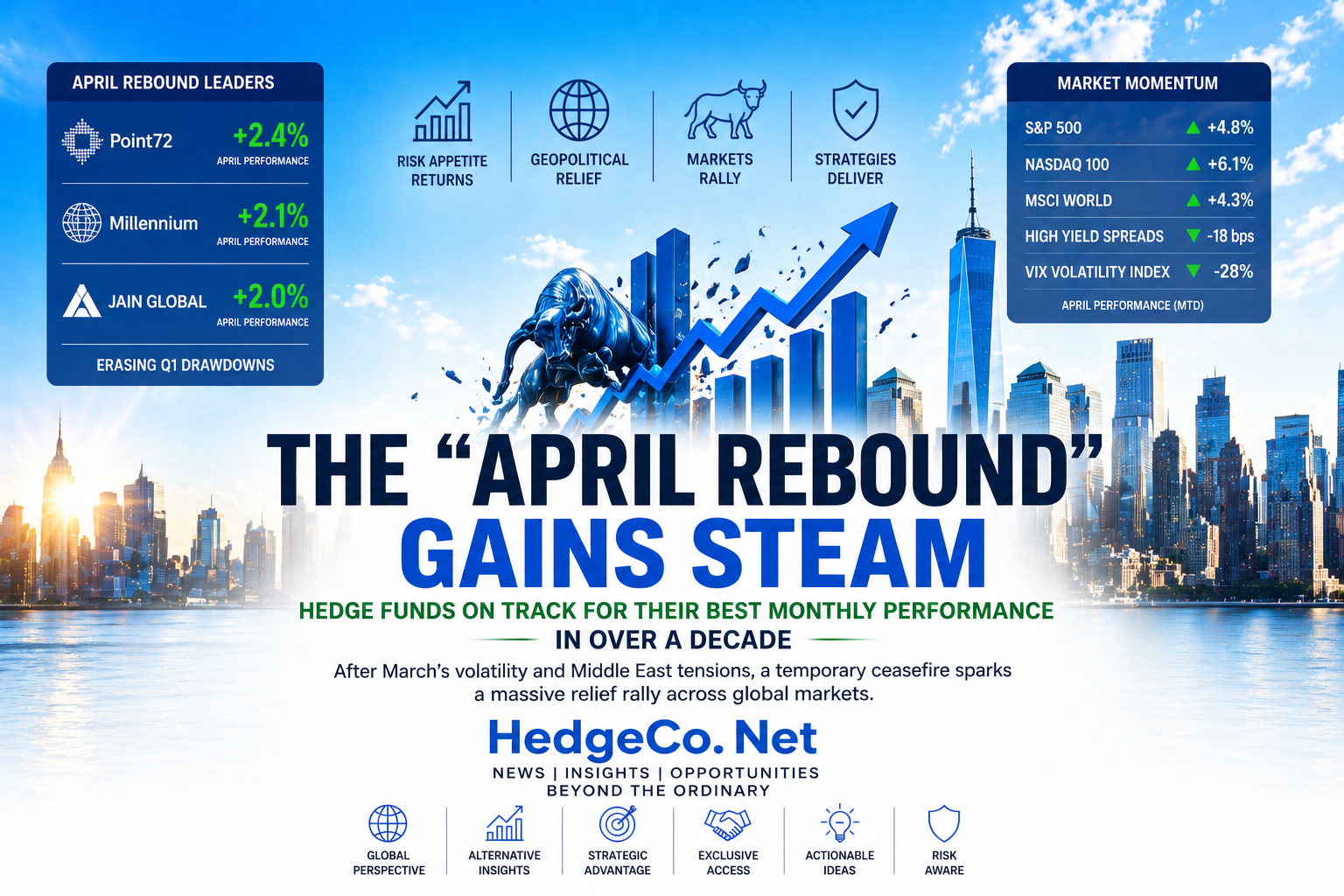
(HedgeCo.Net) After a volatile and, at times, deeply unsettling March, hedge funds are mounting a powerful comeback—one that is rapidly shaping up to be the strongest monthly performance in more than a decade. What began as a fragile stabilization has evolved into a broad-based rally across strategies, driven by a combination of geopolitical de-escalation, repositioning flows, and renewed risk appetite across global markets.
At the center of this resurgence is a shift in macro sentiment. A temporary ceasefire in the Middle East has alleviated one of the most acute sources of market stress, triggering a relief rally that has cascaded across equities, credit, and commodities. For hedge funds—many of which entered April defensively positioned—the move has created a fertile environment for performance recovery.
Early indications suggest that leading multi-strategy platforms such as Point72, Millennium Management, and Jain Global have not only participated in the rebound but, in many cases, have erased a significant portion of their first-quarter drawdowns. Point72 is reportedly up approximately 2.4% for the month, while Millennium and Jain Global have staged comparable recoveries.
From March Volatility to April Momentum
To fully understand the significance of April’s rebound, it is necessary to revisit the conditions that defined March. Markets were gripped by a convergence of macro risks, including escalating tensions in the Middle East, persistent inflation concerns, and uncertainty surrounding central bank policy trajectories.
Risk assets sold off sharply as investors moved to de-risk portfolios, leading to heightened volatility across asset classes. Hedge funds, particularly those with exposure to macro and event-driven strategies, experienced drawdowns as correlations spiked and liquidity conditions tightened.
However, March’s volatility also created the conditions for a potential rebound. Positioning became increasingly defensive, with many funds reducing exposure, raising cash levels, and hedging downside risks. This reset in positioning proved to be a critical factor in enabling the rapid recovery seen in April.
As geopolitical tensions eased with the announcement of a temporary ceasefire, markets responded with a surge in risk appetite. Equities rallied, credit spreads tightened, and volatility declined. Hedge funds, which had entered the month with relatively conservative positioning, were well-positioned to redeploy capital and capture the upside.
The Mechanics of a Relief Rally
Relief rallies are a distinct phenomenon in financial markets, characterized by sharp, often rapid price movements driven by the removal or reduction of a key risk factor. In this case, the easing of geopolitical tensions acted as a catalyst for a broad-based repricing of risk.
For hedge funds, the dynamics of a relief rally present both opportunities and challenges. On one hand, the rapid shift in sentiment can generate significant alpha opportunities, particularly for funds that are able to quickly adjust positioning. On the other hand, the speed and magnitude of the move can create execution risks, as markets may overshoot or exhibit increased volatility.
In April, the balance appears to have tilted decisively in favor of opportunity. Multi-strategy platforms, with their diversified approach and ability to allocate capital dynamically across strategies, have been particularly well-suited to capitalize on the environment.
These firms typically operate with a “pod” structure, in which individual portfolio managers run distinct strategies within a centralized risk framework. This model allows for rapid reallocation of capital to areas of opportunity, enabling firms to respond quickly to changing market conditions.
Equity Long/Short: A Key Driver of Performance
One of the primary beneficiaries of the April rebound has been equity long/short strategies. As equity markets rallied, funds with net long exposure have seen significant gains, particularly in sectors that were heavily sold off in March.
Technology and AI-related stocks, which had experienced volatility amid concerns about valuation and regulatory scrutiny, have rebounded strongly. Similarly, cyclical sectors such as industrials and financials have benefited from improved macro sentiment.
Stock dispersion—a critical factor for equity long/short managers—has also increased, creating opportunities for alpha generation on both the long and short sides of the portfolio. Managers who were able to identify mispricings during the March selloff have been rewarded as markets normalized.
Macro and Systematic Strategies Rebound
Macro strategies, which had faced challenges during March’s volatile environment, have also staged a recovery. The stabilization of interest rate expectations and the easing of geopolitical risks have created a more favorable backdrop for directional trades.
Systematic and quantitative strategies have similarly benefited from the normalization of market conditions. As volatility declined and trends became more defined, these strategies were able to re-engage with the market, capturing momentum across asset classes.
The interplay between discretionary and systematic strategies has been a notable feature of the April rebound, with both approaches contributing to overall performance.
The Role of Positioning and Risk Management
One of the defining characteristics of the April rebound has been the role of positioning. The defensive posture adopted by many hedge funds in March provided a foundation for the subsequent recovery.
By reducing exposure and preserving capital during the downturn, funds were able to maintain the flexibility needed to capitalize on the rebound. This underscores the importance of risk management as a core component of hedge fund performance.
In an environment characterized by rapid shifts in sentiment, the ability to dynamically adjust positioning is critical. Funds that are able to strike the right balance between risk and opportunity are best positioned to navigate these conditions.
Capital Flows and Investor Sentiment
The strong performance of hedge funds in April is also likely to influence capital flows into the sector. After a period of mixed returns and investor skepticism, a sustained rebound could reignite interest in hedge fund strategies.
Institutional investors, in particular, are closely monitoring performance trends as they evaluate allocations. The ability of hedge funds to deliver positive returns in a challenging environment reinforces their role as diversifiers within a broader portfolio.
At the same time, the wealth channel continues to play an increasingly important role in capital formation. High-net-worth investors and financial advisors are seeking strategies that can deliver consistent returns and manage downside risk—objectives that align well with the capabilities of hedge funds.
Is the Rebound Sustainable?
While the April rebound has been impressive, questions remain about its sustainability. Relief rallies, by their nature, can be short-lived, particularly if underlying risks re-emerge.
Geopolitical tensions, while temporarily eased, have not been fully resolved. Inflation remains a concern, and central banks continue to navigate a complex policy environment. Any deterioration in these factors could disrupt the current momentum.
However, there are reasons to believe that the rebound may have more staying power. The reset in positioning, combined with improved market sentiment and supportive technical factors, suggests that the rally could extend beyond the immediate aftermath of the ceasefire.
Moreover, the structural drivers of hedge fund performance—such as increased market dispersion and the growing complexity of global markets—remain intact.
A New Performance Cycle for Hedge Funds?
The strength of the April rebound raises the possibility that the hedge fund industry may be entering a new performance cycle. After years of mixed results and intense competition from passive strategies, hedge funds are demonstrating their ability to generate alpha in a dynamic environment.
This potential shift is being driven by several factors, including:
- Increased Market Volatility: Creating opportunities for active management
- Greater Dispersion: Enhancing the potential for stock selection
- Macro Complexity: Providing a fertile ground for macro and multi-strategy approaches
- Technological Advancements: Enabling more sophisticated analysis and execution
If these trends continue, hedge funds could see a resurgence in both performance and capital inflows.
Implications for the Industry
The April rebound has important implications for the hedge fund industry. It highlights the resilience of the multi-strategy model and underscores the value of diversification and risk management.
For investors, the rebound reinforces the importance of maintaining exposure to hedge funds as part of a diversified portfolio. While performance can be volatile in the short term, the ability of hedge funds to adapt to changing market conditions remains a key differentiator.
For managers, the current environment presents both opportunities and challenges. Sustaining performance will require continued innovation, disciplined risk management, and the ability to navigate an increasingly complex market landscape.
Conclusion
The “April Rebound” is more than just a strong month for hedge funds—it is a powerful reminder of the industry’s ability to navigate volatility and capitalize on opportunity. As markets continue to evolve, the role of hedge funds as active managers and risk mitigators remains as relevant as ever.
While uncertainties persist, the current momentum suggests that hedge funds are well-positioned to deliver value in the months ahead. Whether this marks the beginning of a sustained performance cycle remains to be seen, but for now, the message is clear: hedge funds are back in the spotlight—and they are delivering.