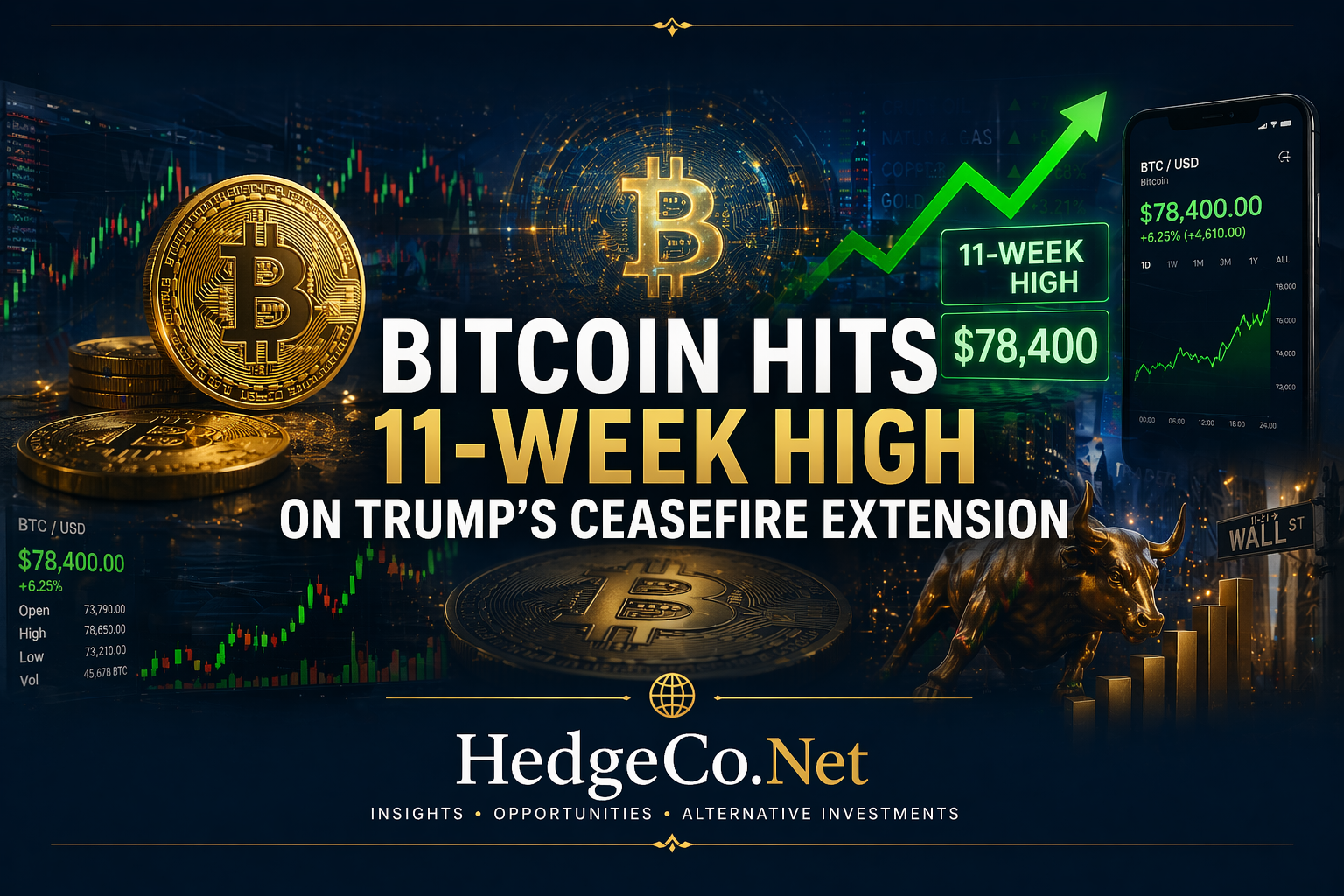
(HedgeCo.Net) Bitcoin surged to its highest level in nearly three months this week, breaking above the $78,000 threshold and reigniting bullish momentum across the digital asset ecosystem. The rally, triggered by an unexpected geopolitical catalyst—an open-ended ceasefire extension announced by Donald Trump—has underscored once again how macro events are increasingly intertwined with the trajectory of crypto markets. What began as a policy announcement aimed at stabilizing tensions in the Middle East rapidly translated into a powerful risk-on signal, unleashing a wave of buying pressure that cascaded through Bitcoin and the broader digital asset complex.
The move was swift and decisive. Within hours of the ceasefire announcement, Bitcoin spiked sharply, forcing bearish traders to unwind positions in what became one of the largest short squeezes of the year. Data across major derivatives exchanges revealed more than $330 million in liquidations, with the vast majority stemming from leveraged short positions that had been betting on continued downside amid geopolitical uncertainty. As those positions were forcibly closed, the resulting buying pressure amplified the upward move, creating a self-reinforcing rally that carried Bitcoin to an 11-week high.
The Geopolitical Catalyst
Markets had been bracing for further escalation in the Iran conflict, with many investors rotating into defensive assets and reducing exposure to risk-sensitive trades. The sudden shift toward de-escalation, therefore, caught positioning off guard. By extending the ceasefire indefinitely, the Trump administration effectively removed a near-term tail risk that had been weighing on global markets.
This change in sentiment was immediately reflected in traditional asset classes. Equities rallied, oil prices stabilized, and volatility indices declined. But it was in the crypto markets where the reaction proved most pronounced. Bitcoin, often described as both a risk asset and a macro hedge, responded aggressively as traders recalibrated their outlook.
“The ceasefire extension acted as a release valve,” said one digital asset strategist. “You had a market that was heavily positioned for downside risk, and suddenly that risk was taken off the table. Bitcoin became the fastest-moving expression of that shift.”
The Anatomy of a Short Squeeze
At the heart of the rally was a classic short squeeze dynamic. In the days leading up to the announcement, funding rates across perpetual futures markets had turned negative, indicating a growing bias toward short positions. Open interest remained elevated, suggesting that traders were increasingly confident in a bearish thesis tied to geopolitical instability.
When the ceasefire news broke, that positioning became a liability. As prices began to rise, short sellers were forced to buy back Bitcoin to cover their positions, pushing prices higher still. This feedback loop accelerated rapidly, particularly on high-leverage platforms where liquidation thresholds are tightly defined.
The scale of the squeeze—over $330 million in liquidations—speaks to the degree of leverage embedded in the system. While such events can create outsized gains in a short period, they also highlight the fragility of markets driven by derivatives activity. In many ways, the rally was less about new capital entering the space and more about existing positions being unwound.
Institutional Flows Reassert Themselves
Beyond the mechanical effects of the short squeeze, there are signs that institutional participation is once again playing a meaningful role in Bitcoin’s price action. Over the past year, the approval and launch of multiple spot Bitcoin ETFs have provided traditional investors with easier access to the asset class, fundamentally altering the market structure.
Large asset managers, including BlackRock and Fidelity Investments, have brought significant credibility and capital into the space. Meanwhile, firms like Morgan Stanley have moved beyond distribution into active management of digital asset products, signaling a deeper integration of crypto into mainstream finance.
The recent rally appears to have coincided with renewed inflows into these vehicles, suggesting that institutional investors are not merely passive participants but are increasingly responsive to macro signals. The easing of geopolitical tensions may have provided a window for allocators to re-engage with risk assets, with Bitcoin serving as a high-beta proxy.
Bitcoin’s Dual Identity: Risk Asset or Safe Haven?
One of the more intriguing aspects of Bitcoin’s behavior in this episode is the ongoing debate ??? its role in the global financial system. Traditionally, assets that benefit from geopolitical de-escalation—such as equities—are considered “risk-on,” while safe havens like gold tend to perform better during periods of questions. Bitcoin, however, continues to defy easy categorization. In this instance, it rallied alongside equities, suggesting a risk-on profile. Yet in previous episodes of market stress, it has also been framed as a hedge against systemic risk and currency debasement.
This dual identity reflects the evolving nature of the asset class. As institutional adoption grows, Bitcoin is increasingly influenced by the same macro forces that drive traditional markets. At the same time, its decentralized architecture and finite supply continue to underpin narratives ??? its long-term store-of-value proposition.
The Role of Liquidity and Market Structure
Another critical factor behind the recent move is the state of liquidity in crypto markets. Compared to previous cycles, liquidity remains relatively fragmented, with trading activity spread across a wide range of centralized and decentralized venues. This fragmentation can exacerbate price moves, particularly large orders hit thin order books.
Market makers, many of whom have scaled back in the wake of regulatory scrutiny, are also playing more of a role than in prior years. This reduced presence can lead to wider spreads and more pronounced volatility, especially during periods of rapid price movement.
At the same time, the growth of algorithmic trading and high-frequency strategies has introduced new dynamics. These systems can amplify trends, reacting to price signals and order flow in milliseconds. In the context of the short squeeze, such strategies likely contributed to the ???? and magnitude of the rally.
Macro Backdrop: A Shifting Landscape
The ceasefire extension is just one piece of a broader macro puzzle that continues to shape Bitcoin’s trajectory. Central bank policy, inflation trends, and currency dynamics all play a role in determining investor appetite for digital assets.
In recent months, expectations, interest rate cuts have fluctuated, creating uncertainty across financial markets. Lower rates typically assist risk assets by reducing the opportunity cost of holding non-yielding investments like Bitcoin. Conversely, a more hawkish stance can weigh on prices.
The geopolitical environment adds another layer of complexity. While the ceasefire has eased immediate tensions, underlying conflicts remain unresolved. Any renewed escalation could shift sentiment and trigger volatility across asset classes, including crypto.
Retail Participation and Sentiment
While institutional flows are increasingly important, retail investors continue to play a significant role in crypto markets. The recent rally has reignited interest among individual traders, many of whom were sidelined during periods of consolidation.
Social media activity, search trends, and trading volumes on retail-focused platforms have all shown signs of uptick, suggesting that momentum is drawing participants back into the market. This influx of retail capital can further fuel price movements, particularly in an environment already characterized by limited liquidity.
However, retail-driven rallies can also be fragile. Sentiment can shift quickly, and without sustained institutional, gains may prove difficult to maintain. The interplay between retail enthusiasm and institutional discipline will be a key factor to watch in the coming weeks.
Regulatory Overhang
No discussion of Bitcoin’s outlook would be complete without addressing the regulatory landscape. Governments around the world continue to grapple with how to oversee digital assets, balancing innovation with investor protection.
In the United States, regulatory clarity remains a work in progress, with agencies such as the U.S. Securities and Exchange Commission and the Commodity Futures Trading Commission playing central roles. Recent developments, including the approval of spot ETFs, suggest a more constructive stance, but uncertainties persist.
Globally, approaches vary widely, from supportive frameworks in jurisdictions like the UAE and Singapore to more restrictive policies elsewhere. These questions can influence capital flows and market dynamics, adding another layer of complexity for investors.
Looking Ahead: Sustainability of the Rally
The key question now is whether Bitcoin can sustain its recent gains or whether the move represents a short-term solution to a specific catalyst. While the technical breakout above $78,000 is significant, maintaining momentum will likely require continued inflows and supportive macro conditions.
Analysts are divided. Some argue that the combination of institutional adoption, supply growth, and improving sentiment could further upside. Others caution that the rally may have outpaced fundamentals, particularly if driven largely by derivatives activity rather than spot demand.
Technical indicators also offer mixed signals. While momentum has turned positive, overbought conditions could lead to near-term consolidation or pullbacks. The next few weeks will be critical in determining whether Bitcoin can establish a new range or whether volatility will once again dominate.
Conclusion: A Market in Transition
The surge to an 11-week high following the Trump ceasefire extension highlights the increasingly complex and interconnected nature of Bitcoin’s market dynamics. No longer operating in isolation, the asset is now deeply embedded in the broader financial ecosystem, responding to the same geopolitical and macroeconomic forces that drive traditional markets.
At the same time, the mechanics of the rally—particularly the role of leveraged positions and short squeezes—serve as a reminder that crypto markets retain unique characteristics. Volatility remains a defining feature, creating both opportunities and risks for participants.
As the digital asset space continues to evolve, events like this will likely become more common. The challenge for investors is to navigate a landscape where macro signals, market structure, and sentiment intersect in increasingly different ways.
For now, Bitcoin’s latest rally stands as a testament to its resilience and adaptability. Whether it can build on this momentum will depend on a delicate balance of factors—but one thing is clear: in today’s markets, even a geopolitical ceasefire can spark a crypto surge.