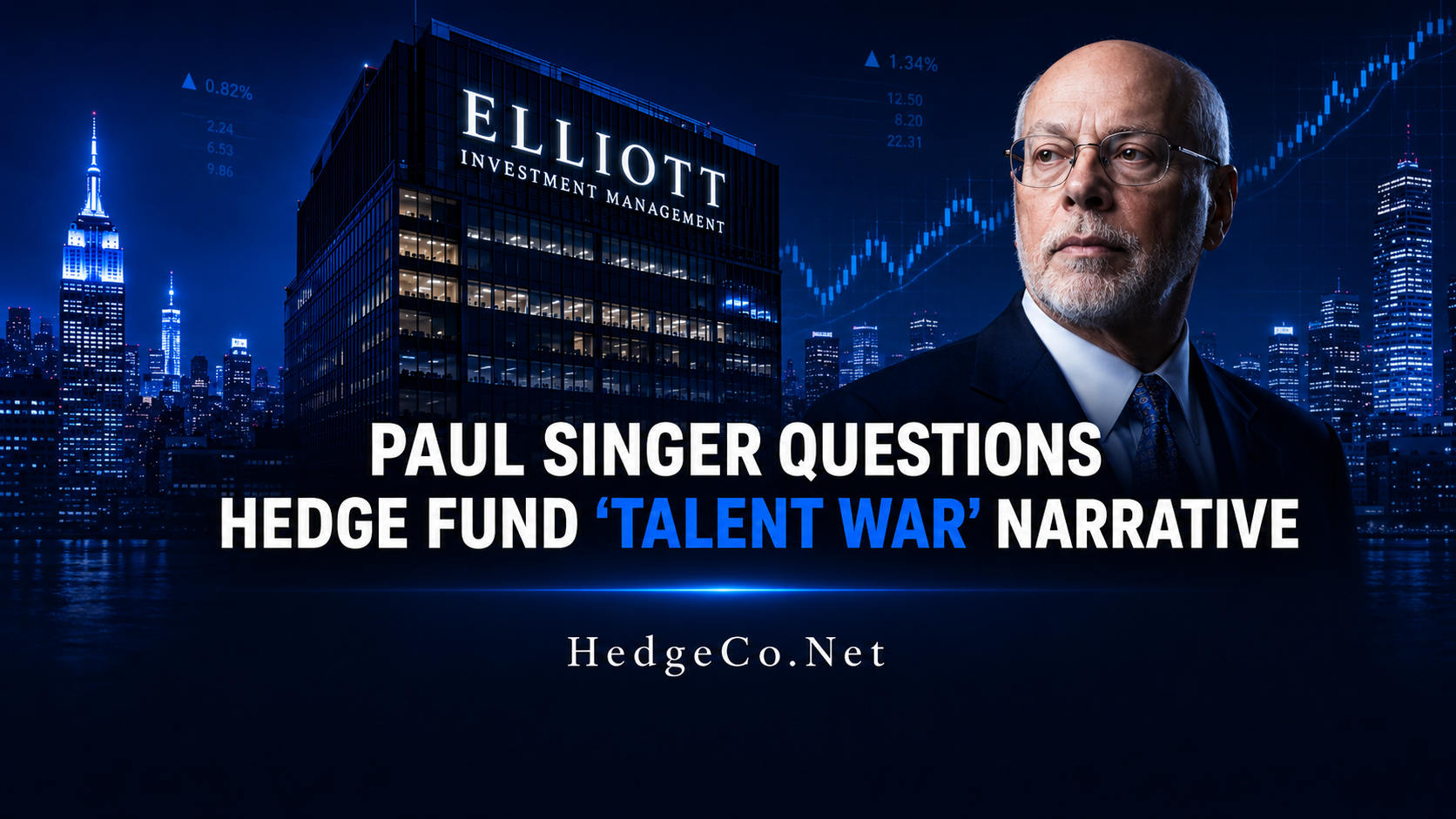
(HedgeCo.Net) — Paul Singer has never been known for accepting Wall Street’s favorite narratives at face value. The founder of Elliott Investment Management has built one of the most durable franchises in hedge funds by questioning consensus, preparing for disorder, and avoiding the assumption that today’s market conditions will last forever. Now, Singer is turning that skeptical lens toward one of the hedge fund industry’s most talked-about themes: the so-called talent war.
In a recent investor letter, Singer argued that the hedge fund talent shortage narrative has been overstated, suggesting that the surge in pay packages, bidding wars for portfolio managers, and aggressive recruitment by mega multi-strategy platforms may owe more to favorable markets, rising fees, and a long period without a severe downturn than to a permanent shortage of exceptional investment talent. Business Insider reported that Singer described the talent-war narrative as exaggerated, framing today’s compensation environment as a byproduct of good markets and higher fees rather than proof that the industry faces a structural scarcity of great money managers.
It is a provocative argument because it challenges one of the dominant assumptions shaping hedge funds in 2026. Over the past several years, firms such as Millennium, Citadel, Point72, Balyasny, Schonfeld, ExodusPoint, and other platform managers have spent aggressively to recruit analysts, traders, portfolio managers, quantitative researchers, engineers, and data specialists. The result has been a compensation arms race that has reshaped the economics of hedge fund employment.
But Singer’s point is that high pay does not automatically equal rare talent. Sometimes it simply reflects excess capital, fee growth, and a bull-market environment in which more people appear skilled because the market has not yet fully tested them. That distinction matters.
The Talent War Becomes the Hedge Fund Industry’s Central Obsession
For much of the hedge fund industry, talent has become the most valuable scarce resource. Capital is available to the largest firms. Technology can be bought. Data can be licensed. Financing relationships can be negotiated. But a portfolio manager who can generate repeatable, risk-controlled alpha remains difficult to find.
That belief has fueled the rise of the multi-manager platform model. The largest pod shops now operate less like traditional hedge funds and more like industrial-scale investment organizations. They recruit teams across equities, credit, macro, commodities, systematic strategies, volatility, and event-driven investing. They allocate capital dynamically. They monitor risk centrally. They cut underperformers quickly. And they reward successful portfolio managers with compensation packages that can reach staggering levels.
Business Insider reported earlier this year that hedge funds, especially large multi-strategy firms such as Millennium, Citadel, Point72, and Balyasny, have become a bright spot in a difficult job market, expanding recruiting pipelines, building internship programs, and creating structured career paths designed to produce future portfolio managers.
That institutionalization of hedge fund careers is a major change. In the older model, talent was often discovered through unconventional paths. A trader developed an edge. An analyst built a differentiated view. A founder assembled a team around a specific strategy. Today, the largest firms are building farm systems, training programs, and internal pipelines that look more like elite corporate development tracks. The logic is clear: if talent is scarce, build it early and keep it close.
Singer is not denying that strong investment talent matters. Elliott’s own history proves the opposite. What he is questioning is whether the current frenzy reflects a true shortage — or whether the industry has simply become willing to pay almost any price for people who appear productive during a favorable regime.
A Bull Market Can Make Talent Look Bigger Than It Is
Singer’s argument goes to the heart of hedge fund evaluation. In rising markets, many investors look skilled. Equity long-short managers can benefit from beta. Credit managers can benefit from spread compression. Event-driven managers can benefit from easy financing and active deal markets. Multi-strategy platforms can benefit from abundant liquidity, higher gross exposure, and strong risk appetite. But bear markets tell a different story.
Singer’s view, as reported by Business Insider and summarized by Hedgeweek, is that many money managers have not been tested by a serious downturn, and that a difficult market would force investors to reassess what true investment excellence looks like.
That is a classic Elliott-style point. The firm has long been associated with defensive positioning, distressed investing, activism, legal complexity, hedging, and a willingness to operate in uncomfortable markets. Elliott’s approach has never been simply about chasing the hottest trade. It is about capital preservation, asymmetry, and exploiting disorder. In that context, Singer’s skepticism about the talent war is not just commentary on compensation. It is commentary on market discipline.
A long bull market can blur the line between skill and environment. It can reward leverage. It can reward crowded trades. It can reward aggressive hiring. It can reward managers who look brilliant because liquidity is abundant and volatility is manageable. The question is what happens when that changes.
The Mega-Platform Model Faces a Cost Test
Singer’s comments land at a time when the largest hedge fund platforms are more powerful than ever — but also more expensive than ever. The multi-manager model has created an ecosystem where top portfolio managers can command enormous guarantees, revenue shares, infrastructure support, and sometimes restrictive employment terms. The firms justify those costs by arguing that elite talent can generate alpha at scale and that centralized risk controls can prevent individual losses from damaging the broader platform.
In good years, that model works. Investors tolerate high fees and pass-through expenses when returns are consistent and drawdowns are limited. But when returns slow, the expense burden becomes harder to ignore.
This is where Singer’s criticism becomes especially important. If the talent war is truly driven by scarce alpha generators, then high compensation may be rational. But if the talent war is inflated by strong markets, high fees, and a shortage of recent stress tests, then the industry may be overpaying for performance that is less durable than advertised. That is a major issue for allocators.
Institutional investors have increasingly accepted pass-through fee models because the biggest platforms have delivered steadier returns than many traditional hedge funds. But those investors are also becoming more sophisticated in evaluating whether they are paying for alpha, capacity, diversification, or simply access to a very expensive machine. Singer’s argument suggests that the industry may be due for a reset.
Elliott’s Different Position in the Hedge Fund Landscape
Elliott occupies a distinct place in this debate. The firm is not a classic pod shop in the Millennium or Citadel sense. It is not built around hundreds of small portfolio teams operating under a high-turnover capital-allocation system. Elliott is a more concentrated, activist, distressed, and event-driven franchise with a long institutional memory and a deeply embedded culture.
That difference matters. Elliott’s business model depends less on recruiting dozens of interchangeable portfolio managers and more on maintaining an experienced organization capable of executing complex campaigns across public equities, credit, restructurings, sovereign debt, litigation, private equity-style control situations, and corporate activism.
The firm has grown significantly over the decades and is now one of the largest hedge fund managers in the world. Business Insider described Elliott as managing nearly $80 billion, while other recent industry summaries put the firm’s assets in the high-$70-billion range.
But Elliott’s scale does not make it a typical platform. Its edge is rooted in judgment, patience, legal sophistication, and a willingness to take confrontational positions when it believes value is being trapped or misallocated. That is different from a pod-shop model built around continuous hiring, rapid risk turnover, and high-frequency capital reallocation across many independent teams.
Singer’s skepticism may therefore reflect the experience of a different hedge fund generation. He is looking at today’s arms race and asking whether the industry has confused compensation momentum with investment greatness.
The Compensation Cycle May Not Last Forever
One of Singer’s most important points is that pay cycles are cyclical. Hedge fund compensation often rises when returns are strong, assets are growing, and investors are willing to tolerate higher fees. It falls when performance disappoints, redemptions rise, margins compress, or markets punish crowded trades. That has happened before, and Singer appears to believe it can happen again.
The current market has created an unusual environment. Even as many parts of finance have become more cautious on hiring, hedge funds have continued to recruit aggressively. Business Insider noted that large multistrategy firms have expanded career pipelines, internships, and junior development programs even as other financial sectors face a more difficult labor market.
That makes hedge funds a rare source of opportunity for young finance professionals. But it also raises questions about sustainability. If every large platform is building a pipeline of future portfolio managers, the industry may eventually face not a talent shortage, but a capacity problem.
There are only so many scalable alpha opportunities. There are only so many trades that can absorb billions of dollars without crowding. There are only so many managers who can produce differentiated returns after costs. If compensation growth outruns true alpha production, the economics will eventually tighten.
Talent Is Real — But So Is Crowding
None of this means the hedge fund talent war is imaginary. The best portfolio managers are valuable. The best risk takers are rare. The best analysts and quant researchers can create measurable advantages. And the biggest firms do compete fiercely for them.
But Singer’s critique is more subtle. He is not saying talent does not matter. He is saying the current narrative may overstate scarcity and understate the role of market conditions.
That is an important distinction because hedge funds are not competing for talent in a vacuum. They are competing in a world where similar firms use similar data, hire from similar pools, trade similar assets, and increasingly operate similar platform structures. When too much capital chases the same types of people using the same playbook, returns can compress.
The industry has seen this before. Strategy crowding can emerge in merger arbitrage, convertible arbitrage, statistical arbitrage, long-short equity, credit relative value, volatility, and macro trades. The same can happen in talent markets. If every firm wants the same profile — a market-neutral portfolio manager with a portable track record, a tight risk process, and a team ready to move — the price of that profile rises. But the incremental alpha may not rise with it. That is the risk Singer appears to be highlighting.
A Bear Market Would Redefine the Debate
The true test of the talent-war narrative will not come in another strong year. It will come in a difficult one. A serious bear market, credit event, liquidity shock, or volatility regime change would reveal which managers are generating durable alpha and which are benefiting from structure, leverage, beta, or favorable conditions. It would also reveal whether the industry’s highest-paid portfolio managers can protect capital when the opportunity set becomes more hostile.
Singer’s suggestion that many managers have not been fully tested by a bear market is especially relevant because hedge fund investors are not simply paying for upside. They are paying for resilience. They are paying for the ability to avoid catastrophic losses. They are paying for independent return streams when traditional assets struggle.
If expensive talent fails that test, investors will question the compensation model. That is why this debate matters far beyond hiring desks. It reaches into fee structures, platform valuations, allocator due diligence, risk management, and the long-term economics of hedge fund investing.
The Investor View: Are Fees Funding Alpha or Infrastructure?
For allocators, the talent war raises a practical question: what exactly are investors paying for? In the mega-platform model, investors may be paying for access to many things at once: portfolio managers, analysts, data, technology, risk systems, financing, compliance, execution, and centralized capital allocation. Some of that spending is essential. A global hedge fund platform cannot operate cheaply.
But investors increasingly want to know whether rising expenses are producing better returns or simply supporting a larger machine. If compensation packages rise faster than performance, the model becomes more vulnerable to criticism. Singer’s comments give voice to a concern many allocators already have. The biggest platforms may remain attractive, but investors are becoming more selective about capacity, fees, transparency, and performance attribution. They want to know whether talent is truly scarce or whether the industry has created a self-reinforcing pay spiral.
Why Singer’s Critique Carries Weight
Singer’s comments matter because he is not an outsider criticizing hedge funds from the sidelines. He is one of the industry’s defining figures. Elliott has survived multiple market cycles, built a global activist and distressed platform, and remained relevant in a hedge fund industry that has repeatedly reinvented itself. Singer’s perspective comes from decades of watching markets reward excess and then punish it.
That does not make him automatically right. The mega-platform firms have strong arguments of their own. Citadel, Millennium, and others have delivered long records of risk-controlled performance. They have built sophisticated systems that many traditional funds cannot replicate. They argue that talent really is scarce, and that paying for it is rational when the alternative is mediocre returns. But Singer’s warning is still important because it questions whether today’s compensation environment is being treated as permanent when it may be cyclical. In finance, that is usually the most dangerous assumption.
The Bottom Line
Paul Singer’s challenge to the hedge fund talent-war narrative is not just a comment about pay. It is a broader warning about markets, incentives, and the difference between true skill and favorable conditions.
The hedge fund industry has spent years escalating the competition for portfolio managers and investment teams. Mega multi-strategy platforms have turned talent acquisition into a strategic weapon. They have built training pipelines, paid enormous packages, and reshaped the career path for ambitious investors.
But Singer is asking whether the industry has gone too far in treating the current environment as proof of permanent scarcity. His argument is that strong markets, higher fees, and a lack of recent bear-market tests may have inflated both compensation and confidence.
That does not mean the talent war is fake. It means the story may be more complicated than the industry wants to admit.
The best managers will always command a premium. The best investors will always be difficult to find. But the ultimate test of talent is not what someone earns during a good market. It is how they perform when capital is scarce, liquidity disappears, volatility rises, and the easy trades stop working. That is the environment Paul Singer has spent a career preparing for. And if he is right, the hedge fund industry’s talent war may not be over — but it may be heading for a much harder exam.